Get Full Government Meeting Transcripts, Videos, & Alerts Forever!
Get email alerts on the Land Use Development topic
No spam. Unsubscribe anytime.
Greenwood planners weigh safety, easement barriers after developer says Holmes Road commitment is impossible
Summary
At a June 9 meeting of the Agreement Advisory Plan Commission in Greenwood, petitioners for Davis Homes LLC said they cannot meet a recorded development commitment to reconstruct Holmes Road across a 300-foot county-owned gap without county easements or property acquisition.
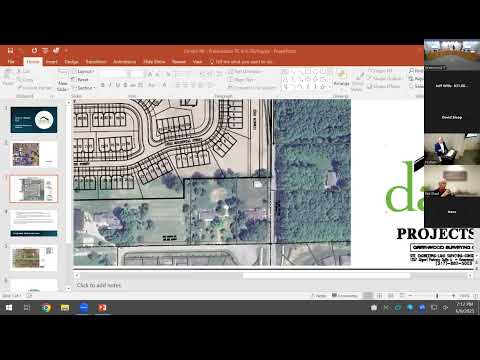
At a June 9 meeting of the Agreement Advisory Plan Commission in Greenwood, petitioners for Davis Homes LLC said they cannot meet a recorded development commitment to “reconstruct Holmes Road to meet standards connecting south” because a roughly 300-foot stretch of county-owned right of way north of an S-curve lies outside the property and is controlled by unwilling adjacent landowners.
Petitioner attorney Eric Prime said Davis Homes has acquired the parcel and plans for-sale townhomes and duplexes rather than the rental development originally contemplated. He told the commission the commitment’s language — as written in item 1b of the recorded commitments — could be read to require reconstruction across the 300-foot county segment but that physically and legally the developer cannot obtain the permanent or temporary easements needed to do that work. “If the board decides that we have to do work in the 300 foot stretch of the county, I think we've just shown you that's an impossibility,” Prime said.
The petitioner’s counsel, Paul Carroll, said his firm had made cash offers for permanent easements and had proposed temporary construction easements and property restorations, including repaving a driveway and replacing disturbed trees, but adjoining owners uniformly declined. “At the last meeting, we had already… approached the adjoining neighbors for affirmative use and… a flat no,” Carroll said. Carroll recounted a face-to-face meeting where owners politely rejected any easement, permanent or temporary.
City staff reiterated that their reading of the commitment is literal and that the city has safety concerns tied to the elevation change and missing pedestrian facilities. A staff member told the commission that Johnson County’s planning director had emailed supporting the city’s position, and that the county recommended at minimum improving the 300-foot section to accommodate traffic and sidewalks if the parties could agree. The staff member said the county’s engineer had conducted a sight-distance check at the 300-foot area and described limited sight distance that prompted a county recommendation for signage and possibly lowering speed limits.
Daniel Johnson, identified in the record as the county engineer and the Greenwood city engineer at the time the original commitment was drafted, provided technical suggestions by email that staff circulated. Those suggestions included analyzing roadway profile changes, sight-distance improvements and, if warranted, lowering the roadway elevation in the problematic segment to meet stopping-sight-distance criteria at the posted speed.
Commission discussion centered on three practical barriers: (1) the 300-foot segment lies outside the petitioner's property and within county jurisdiction, (2) adjoining owners have declined permanent or temporary easements after offers, and (3) the road’s vertical profile creates a sight-distance safety problem. Commissioners and commenters suggested several paths forward: (a) county acquisition or use of eminent domain to secure right of way for a safer alignment, (b) voluntary annexation followed by city-led action (noting the city cannot involuntarily annex the properties), or (c) design changes that shift the roadway east and minimize impacts on private yards but would require land acquisition. One commissioner who visited the site recommended an engineering study to evaluate moving the road east and reducing the roadway cross-section to fit within available land.
A resident who identified themselves as living in the area argued for approving development because Greenwood needs more for-sale housing and low inventory is raising local housing costs. The resident said developers should be given a path forward if public agencies can address right-of-way acquisition.
No formal action to modify the commitment or to require the 300-foot county segment to be improved was taken at the meeting. The public hearing was closed. Commissioners and staff discussed pursuing further coordination with Johnson County to resolve jurisdictional and right-of-way barriers; one commissioner urged the commission to “maintain the status quo” so the city and county would be forced to confer and resolve the gap in practice.
Votes at a glance
• Motion to approve minutes from May 28, 2025 — Moved by Mr. Lexi; seconded by Mr. Probst; outcome: approved, 9-0.
What the record shows and does not
The record includes the petitioner’s presentation, counsel’s summary of neighbor refusals, city staff’s literal reading of commitment 1b and circulation of county engineering comments, and a county planning director email signaling county agreement with city concerns and a recommendation to improve the 300-foot section if parties agree. The transcript records repeated statements that adjoining owners refused easements; it does not record any formal intergovernmental agreement, annexation action, county eminent-domain filing, or a commission vote to change the commitments.
Next steps in the discussion at the meeting were procedural: commissioners urged further discussion and coordination among the city, Johnson County, the petitioner and adjacent property owners. No schedule, funding source or engineering plan was adopted at the June 9 hearing.