Get Full Government Meeting Transcripts, Videos, & Alerts Forever!
Get email alerts on the Child Welfare Restraint Out Of State Placement topic
No spam. Unsubscribe anytime.
House committee advances wide-ranging changes to restraint, out-of-state placement rules for children in care
Summary
The House Rules Committee adopted the A-13 amendment to House Bill 3835A, moving the measure to the Joint Committee on Ways and Means after extended testimony and debate over definitions, out‑of‑state placements and oversight.
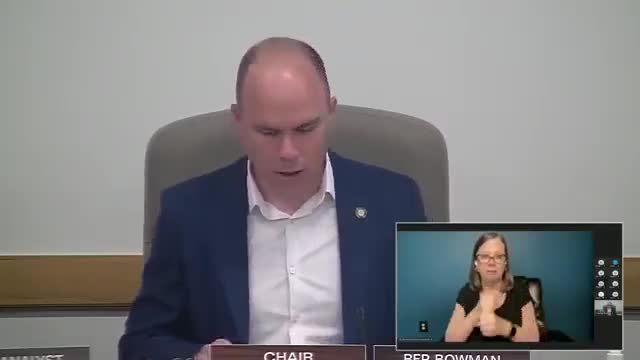
The House Committee on Rules on June 11 adopted amendments to House Bill 3835A, a comprehensive measure that changes when and how restraint and seclusion may be used in child and adult care settings and creates new procedures for out‑of‑state placements of children in state care. The committee approved the A‑13 amendment and voted to send the bill, as amended, to the Joint Committee on Ways and Means.
The bill matters because it rewrites definitions that determine when physical restraint and involuntary seclusion are permitted, alters reporting and licensing requirements for providers, and creates new oversight and reporting tied to out‑of‑state placements — changes advocates say could widen or narrow protections for children depending on implementation.
Committee Vice Chair Pham moved to adopt the A‑13 amendment and the committee adopted it after roll call. The committee then voted to refer House Bill 3835A, as amended, to Ways and Means. Representative Anna Scharf, vice chair of the committee of origin, warned committee members the draft before them “is not an agreed bill by any parties,” said 36 questions by the House Human Services chair remained unanswered and urged caution before passage. She noted an earlier draft concept had been framed as a four‑year, $20 million pilot, while the amendment before the Rules Committee was a fiscal‑light amendment with no set sunset.
Michelle Pfeiffer, legislative coordinator for child welfare at the Oregon Department of Human Services (ODHS), walked the panel through the A‑13 amendments. She said the amendment restores the existing federal CMS‑aligned definition of chemical restraint, clarifies that “voluntary seclusion” may include age‑appropriate time‑out and that secure transport language remained applicable in statute. She described new requirements in Section 36 that a multidisciplinary team member accompany children to out‑of‑state placements, visit them at least every 15 days, and that rules be adopted to protect rights and respond if abuse is alleged in out‑of‑state settings. Pfeiffer also said the amendment requires ODHS to seek court approval for out‑of‑state placements and adjusts reporting dates to Oct. 1, 2025, and January 2026.
Senator Sarah Gelser Blouin, chair of the Senate Human Services Committee, testified in support of an alternate A‑11 amendment she circulated that includes explicit statutory definitions for thresholds such as “serious physical harm,” tighter requirements for medical necessity, and preservation of more granular public reporting about demographics and oversight. Gelser Blouin said removing certain restraint types from the statutory abuse definition but continuing to prohibit them risks creating “secret” practices that avoid accountability. She urged clearer limits on delegation of authority to approve out‑of‑state placements and preservation of public data, saying that earlier out‑of‑state placements had shown racial disparities and gaps in culturally specific services.
Committee members debated tradeoffs between expanding capacity to place children in licensed out‑of‑state medical programs and the need for statutory safeguards and transparency. Supporters said the measure moves capacity policy forward and included safeguards such as court approval and quarterly legislative reporting; opponents and some members asked for more clarity on definitions, delegation of approval, and prosecutable standards. Several LC (Legislative Counsel) opinions and a residential care ombudsman memo were cited during the discussion and placed in the record.
The committee record shows the A‑13 amendment was adopted and the bill ordered to Ways and Means. Committee members made clear they expect continued work in budget and policy committees if the bill advances.
Questions and discussion in the work session focused on three main implementation points: how ODHS would track and report prohibited restraints; what authority SOCAC (System of Care Advisory Council) would have in reviewing placement exceptions versus direct legislative access to data; and whether out‑of‑state facilities must be licensed by an equivalent health authority and tied to Medicaid contracts. ODHS told the committee the A‑13 requires quarterly provider reporting of prohibited restraints and that licensing will review incident reports and, where appropriate, both pursue licensing sanctions and report allegations to the child abuse hotline when thresholds for reckless or excessive force appear to be met.
The committee recorded no change in current law limiting storage or sale of data; members and testifiers referenced OLIS‑posted amendment text and LC opinions as the formal authorities for bill language.
The committee’s action sends the bill to Ways and Means; if the larger bill moves forward, members indicated they expect further deliberations on definitions, oversight pathways, and contract safeguards for any out‑of‑state placements.