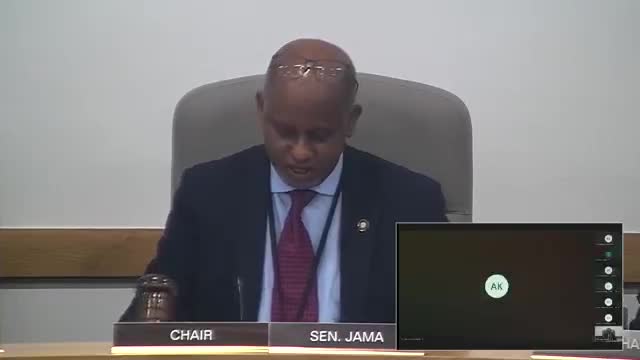
Senate panel adopts narrowed SB 686 amendment to create arbitration, payment paths for Oregon news outlets
Loading...
Summary
The Senate Committee on Rules approved the A‑9 amendment to SB 686, the Oregon Journalism Protection Act, which narrows the bill’s focus to non‑expressive commercial conduct by covered platforms and creates options for written agreements, arbitration or a temporary lump‑sum payment to support local journalism.
The Senate Committee on Rules on Wednesday adopted the A‑9 amendment to Senate Bill 686, the Oregon Journalism Protection Act, advancing the measure to the full Senate with a due‑pass recommendation.
The amendment narrows the bill to regulate non‑expressive commercial conduct by covered online platforms that access and monetize digital journalism providers’ content for Oregon audiences without written agreements. It gives platforms three compliance paths: negotiate written agreements with providers, submit to a final arbitration to determine compensation, or make a time‑limited lump‑sum payment into a fund distributed to journalism providers.
Senator Duy‑Pham, the bill’s sponsor, told the committee the A‑9 was drafted after consultations with legislative counsel and outside counsel to address constitutional concerns. “This amendment is now targeted at non‑expressive conduct,” she said. “A covered platform is presumed to be engaging in an unfair trade practice if the platform is accessing the online content of a digital journalism provider for the purposes of monetizing that online content without a written agreement between those parties.”
The amendment creates the Oregon Civic Information Consortium and allows digital journalism providers to either request compensation from a platform’s annual payment or apply for a grant from the consortium, but not both. It also establishes an arbitration process and allows providers to bring civil actions in some circumstances.
Legislative counsel and staff described key constitutional and procedural changes. Chris Allnatt, deputy legislative counsel, said the A‑9 is drafted to emphasize regulation of commercial conduct rather than speech and that, “a court could reasonably find that the dash 9 is directed at non‑expressive conduct.” Helen Lee, staff attorney, told senators the amendment replaces binding arbitration with an option for a trial de novo (a judicial review), but cautioned that courts may still find Article I, section 17 (jury‑trial) questions. “We do believe that the right to a jury trial applies in this situation,” she said, and added that whether the trial de novo satisfies that right could be litigated.
Committee members pressed the sponsor and counsel on practical effects. Doyle Canning, senior policy adviser to Senator Pham, said platforms that already have agreements (for example, some large outlets) would be exempt from the presumption of unfair trade practice. He also described the multiple compliance options and said the lump‑sum payment is offered as a temporary, optional defense during the two‑year compliance period.
Committee members raised concerns about possible marketplace effects on smaller community outlets and whether platforms could negotiate selectively with only some providers. Vice Chair Bonham asked whether platforms could “make agreements with just right‑wing news media sources and not left‑wing sources,” to which the sponsor’s office responded that the existing commercial status quo allows private parties to contract as they wish and that the bill’s enforcement path aims to offer recourse to Oregon news providers that cannot reach agreements.
Supporters and opponents discussed international examples. Senator Pham and staff cited Canada’s Online News Act as a model that has produced payments to journalism providers, and her office described the A‑9 as a narrower alternative to prior drafts.
The committee adopted the A‑9 amendment and then voted to send SB 686 as amended to the Senate floor with a due‑pass recommendation. A roll call on the amendment and on the motion to move the bill produced recorded ayes and nos (see actions). Several senators said they expect constitutional challenges and noted open legal questions, but also said the legislation addresses a pressing local journalism crisis, particularly for smaller and ethnic media outlets.
The measure now goes to the Senate floor; counsel and sponsors told the committee they expect litigation risks and that some legal issues (including jury‑trial and free‑speech challenges) could be resolved in courts if the bill becomes law.
Senate Bill 686 as amended would create a statewide mechanism for compensating Oregon newsrooms for the commercial use of their online content by covered platforms, while preserving negotiation and arbitration options for both sides.
Less critical details: the fiscal impact statement had not been released during the committee meeting; the A‑9 amendment also lengthened the reporting window platforms must publish (two prior calendar years rather than 12 months) and changed terminology in the draft to use “individual” instead of “natural person.”