Get Full Government Meeting Transcripts, Videos, & Alerts Forever!
Get email alerts on the Menstrual Products topic
No spam. Unsubscribe anytime.
Coalition presses for statewide menstrual product access and ingredient disclosure
Summary
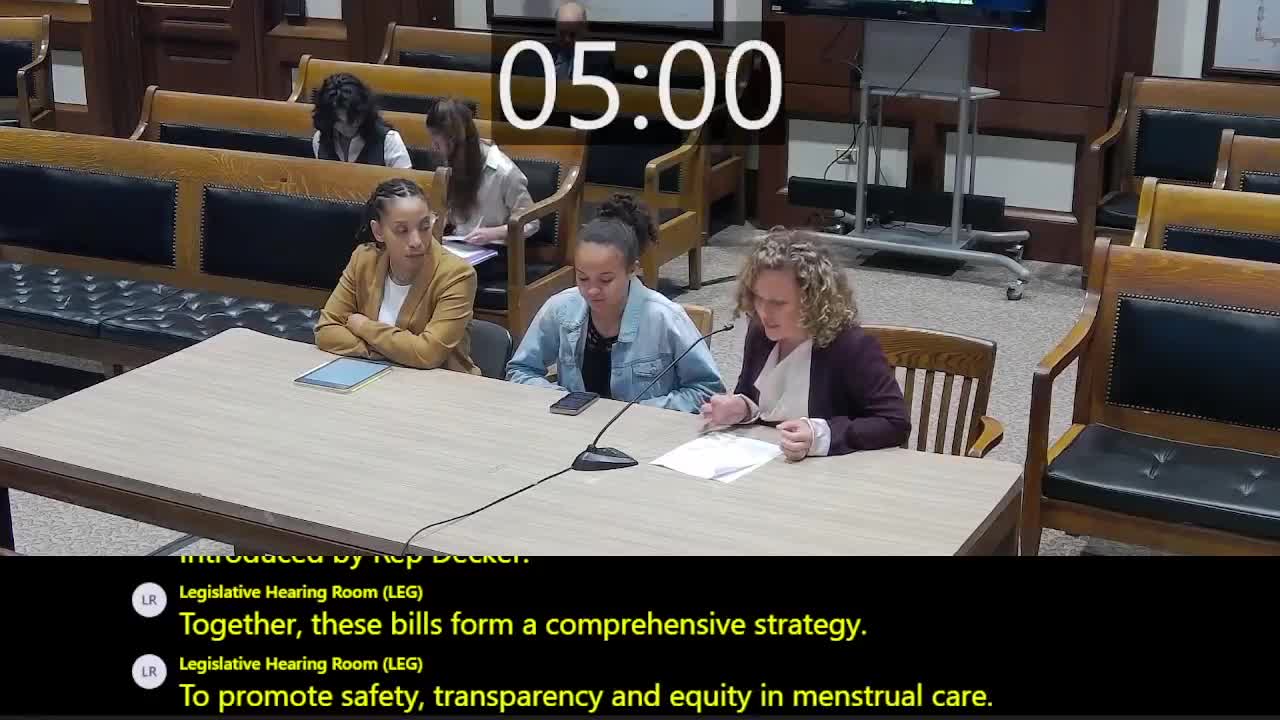
Advocates, municipal officials and vendors urged the Joint Committee on Public Health to advance bills that would require free menstrual products in schools, shelters and correctional facilities and require ingredient disclosure on menstrual product packaging.
A broad coalition of advocates, local officials and vendors urged the Joint Committee on Public Health to advance legislation that would (1) require free access to menstrual products in public schools, homeless shelters and correctional facilities and (2) require ingredient disclosure on menstrual product packaging.
Sasha Gutfreund of MassNOW and Dana Alice of the Boston Mayor’s Office of Women’s Advancement testified in support of H.24 83 / S.15 49 (the "I AM" bill), citing school nurse surveys and municipal pilot programs. "A 2024 survey of 187 school nurses revealed that 70 percent report seeing students miss class due to lack of access to menstrual products," Gutfreund said. City officials described Boston’s program to install free products in bathroom stalls and to produce multilingual educational materials.
Vendors and nonprofits said demand outstrips current supply nationally and locally. Carrie Carter, CEO of Hope and Comfort, said her organization serves more than 500 schools and community organizations and has a waiting list of more than 300 organizations. Periodic Vending Solutions and other vendors described vending and distribution options; students and advocates described stigma reduction and educational benefits.
On ingredient disclosure, Kelly Murphy of Lola and student speakers pointed to recent academic testing that found heavy metals and other contaminants in some tampon samples, and argued for transparency. "Women deserve to know what ingredients are in their tampons and pads so they can take their safety into their own hands," Murphy said. Supporters said ingredient disclosure would mirror food and medicine labeling practices and help consumers, clinicians and procurement officers make informed choices.
Correctional administrators and the Massachusetts Sheriffs Association have endorsed the access bill, and advocates asked the committee to report the measures favorably so districts and state agencies can implement programs statewide.