Get Full Government Meeting Transcripts, Videos, & Alerts Forever!
Get email alerts on the Indoor Air Quality topic
No spam. Unsubscribe anytime.
Advocates urge creation of state task force to tackle indoor air pollution in highly impacted communities
Summary
Supporters of H.2427/S.1546 told the Joint Committee on Public Health that indoor air pollution — including ultrafine particulate matter and black carbon — disproportionately harms environmental justice communities and that a state task force is needed to develop monitoring, remediation and funding recommendations.
Supporters of H.2427 and S.1546 pressed the Joint Committee on Public Health to create a state task force to identify, monitor and remediate indoor air pollution in highly impacted communities.
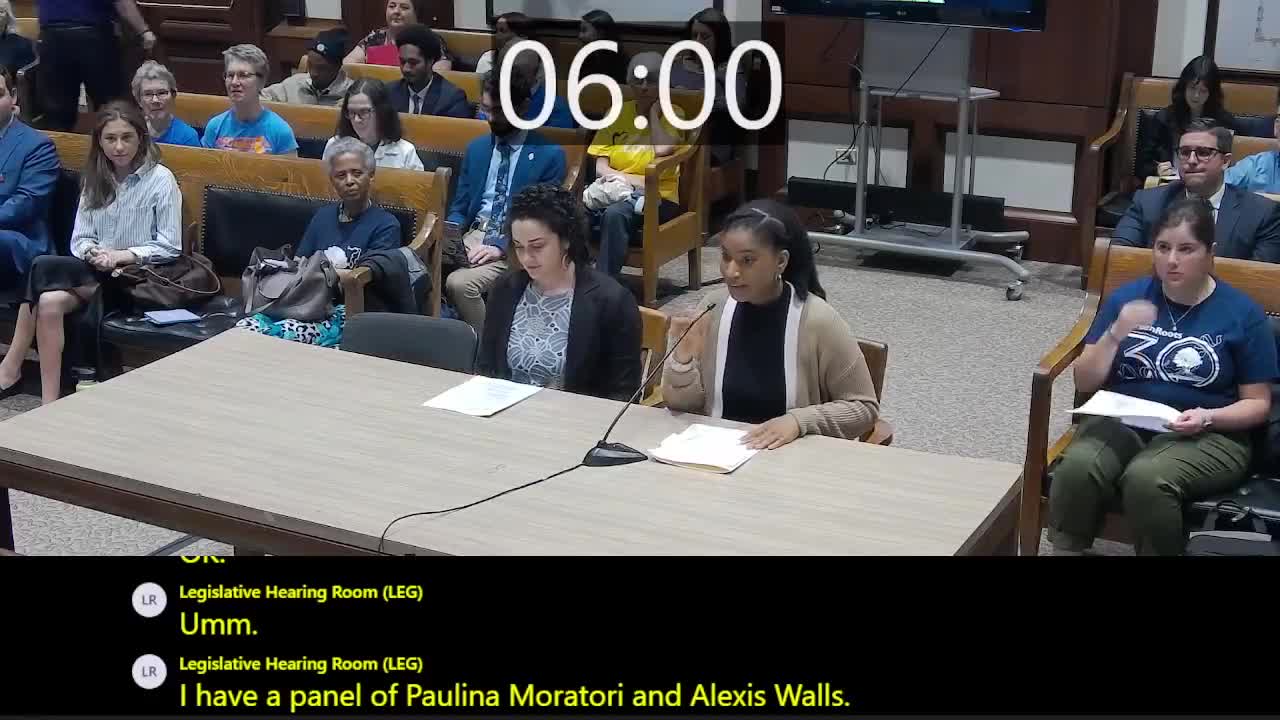
The bill would establish a DPH‑led task force with representatives from the Department of Environmental Protection, the state housing agency and local boards of health, and require work on standards and funding sources. "We are encouraged to see this committee making air quality a legislative priority this session," said Alexis Walls, campaign director at the Massachusetts Public Health Alliance.
Advocates said indoor pollutants often come from outdoors and then concentrate inside homes, schools and public buildings; they singled out ultrafine particulate matter and black carbon as gaps in federal protections. "Indoor air pollution exposure from pollutants that come from the outdoors accounts for 40 to 60% of the health effects of particulate pollution in the U.S.," testified Kevin Shen of the Union of Concerned Scientists. Conservation Law Foundation and neighborhood groups detailed pilot projects that used sensors and HEPA filtration to measure and lower particulates in homes and schools.
Speakers described consistent, community-level impacts in places such as East Boston, Chelsea and Roxbury: older housing, limited HVAC systems in schools and proximity to highways and airports. "Only two of our 12 schools have central HVAC systems," Sonia Tengbald of Mothers Out Front told the committee; Green Roots and Alternatives for Community and Environment presented sensor data and filter pilot results demonstrating reductions in PM2.5 when portable filtration was deployed.
Proponents urged the committee to report the bill favorably so the task force can set monitoring methods, recommend exposure limits and identify sustainable funding. Several witnesses recommended explicit technical standards and called for task force membership to include people with lived experience and field expertise in mold remediation and HVAC assessment. "The bill gives clear guidance around who specifically should comprise the task force as well as clear guidance on a timeline for the task force to complete this work," Paulina Muratore of Conservation Law Foundation said.
The sponsors and supporters asked the committee to balance technical standards with the realities of underfunded housing authorities and municipal boards of health. The bill drew broad support from environmental justice groups, public‑health coalitions and clean‑air advocates who said statewide coordination will be required to close regulatory and enforcement gaps. Committee members signaled interest in further technical detail and in coordination with school and housing authorities.