Get Full Government Meeting Transcripts, Videos, & Alerts Forever!
Get email alerts on the Community Preservation topic
No spam. Unsubscribe anytime.
Southborough CPC agrees to finalize revised CPA application and handbook ahead of public forum
Summary
The Town of Southborough Community Preservation Committee reviewed edits to its application handbook and a new fillable application form, agreed to refine eligibility language and application layout, and planned to finalize materials at a public forum before posting them online.
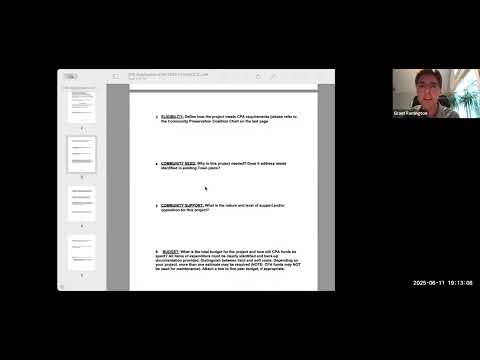
The Town of Southborough Community Preservation Committee on Tuesday reviewed final edits to its Community Preservation Act (CPA) application handbook and a newly created fillable application and agreed to finalize the documents at a public forum before posting them on the town website.
The handbook and application matter because they set the rules and expectations for anyone seeking CPA funding for historic preservation, open space, affordable housing and recreational projects in Southborough. Committee members focused on clarifying eligibility, adding an applicant acknowledgment, tightening questions about alternative funding, and fixing format and printing issues in the new PDF form.
Committee Chair Lisa, chair of the Community Preservation Committee, opened the meeting by placing the application handbook item on the agenda and thanked Grant for preparing the draft: "We can leave this open and just finalize it at the forum at our meeting on the eighteenth," she said, adding it would be posted to the website once finalized.
Katie, who reworked the application into a fillable PDF, described her changes: "I went through all the… and just put in what I thought would be a good, fillable form format… the check boxes should now all be actual boxes you can check." Members raised printing and character-limit concerns for long narrative answers and discussed whether to use a fillable PDF or a Word document to give applicants more room.
Key changes the committee asked to include or test before final publication:
- Move the eligibility chart closer to the start of the application so applicants can verify whether their project is eligible before completing the full form; the committee repeatedly instructed staff to place the chart "up front" and to refer to it in the project-eligibility questions.
- Add a checkbox on the application requiring applicants to acknowledge they have read and understand the CPC application handbook; "I have read and understand the CPC application handbook," was proposed as a required acknowledgment.
- Add a specific question requiring applicants to state if they are "seeking alternative means of funding outside of the CPA process" and list any committed or under-consideration sources; members stressed this should make applicants do the initial homework, rather than leaving the committee to chase funding histories.
- Include the town plans applicants should reference when describing community need — the Master Plan, Open Space and Recreation Plan and the Housing Production Plan — so applicants know which local documents to cite.
- Fix formatting and editorial items: update contact names (remove Ben Smith and list current chair), change application dates (application due date changed to September 15 and references to the annual town meeting year updated to 2026/FY2027 in the draft), correct a missing parenthesis and ZIP code, and ensure printable output from the fillable PDF.
Committee members discussed reporting and timeline expectations for approved projects. Freddie (staff) said project timelines and reporting requirements are set during the application negotiation, and the committee has used a sunset/window approach; members noted a typical reporting cadence raised in the meeting was six-month intervals and that multi-year completion windows are handled case by case ("we added as part of the approved application. We give a a window. Typically, it's 2 years," said Freddie).
The committee also reviewed draft talking points and slides for an upcoming public forum. Members asked that the slide deck show the source of budget and tax-rate numbers (the town assessor) and that the eligibility chart and a line noting the 07/08/2012 legislation prohibiting CPA funds for artificial turf be made explicit on forum materials, because the turf prohibition is a recurring source of confusion.
Separately, committee members reviewed draft signage guidance and examples uploaded to the committee Dropbox: examples included temporary construction lawn signs and two types of permanent plaques (PVC and bronze). Ellen said vendors used by the Historical Commission had produced acceptable signs and that some towns use prominent signs to show "CPA funds at work." The committee discussed requiring signage during projects and including sign costs as an allowable line item in project budgets.
No formal vote to adopt the handbook or application was taken at the meeting. Lisa said the group planned to finalize the application and handbook at the public forum and post them on the website after any remaining edits. The meeting ended with a roll-call adjournment vote.
Next steps: Grant was asked to forward proposed language edits to Katie, who will update the fillable form and handbook text; the committee will vote to adopt the handbook and application at the next meeting and then post the materials online for applicants to use.