Get Full Government Meeting Transcripts, Videos, & Alerts Forever!
Get email alerts on the Public Rights Of Way Accessibility topic
No spam. Unsubscribe anytime.
Worcester officials present ADA self‑evaluation: 7,117 curb ramps inventoried; consultants find most ramps noncompliant with PROWAG
Summary
Stephen Raleigh, Commissioner of Transportation and Mobility for the City of Worcester, presented a draft ADA self‑evaluation and transition plan for the public right of way, saying the city’s first comprehensive inventory shows thousands of curb ramps and sidewalks need work.
Stephen Raleigh, Commissioner of Transportation and Mobility for the City of Worcester, presented a draft ADA self‑evaluation and transition plan for the public right of way, telling the Accessibility Advisory Commission that the city has not previously completed a comprehensive inventory and that the new effort shows the scope of needed work.
The consultant Apex Companies conducted a citywide curb‑ramp and sidewalk inventory, counting 7,117 curb ramps within Worcester jurisdiction. Apex found 72% of ramps are concrete and 28% asphalt; 72% were rated in “good” physical condition, 23% fair and 5% poor. When judged against the Public Rights‑of‑Way Accessibility Guidelines (PROWAG), Apex identified 28 ramps needing minor grinding or detectable‑warning panels and 6,822 ramps they classified as fully noncompliant and requiring reconstruction.
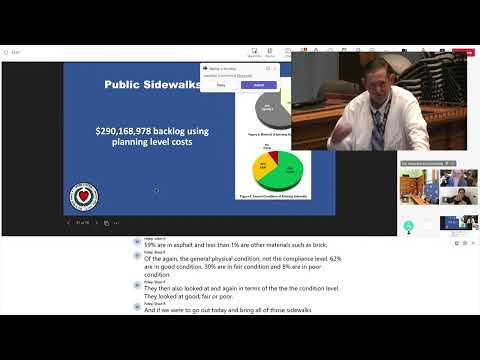
Commissioner Raleigh said the team used both AI mapping and field checks to gather attributes for each ramp and sidewalk segment and excluded ramps on state‑owned rights of way. Todd Corrain, assistant director in the Department of Transportation and Mobility, said the ramp replacement planning‑level cost to bring existing curb ramps into compliance today is $63,584,470; the planning‑level cost to bring sidewalks currently rated fair or poor up to a good condition was discussed at about $290,000,000 and described by staff as an order‑of‑magnitude estimate.
Apex principal Frank Marinaccio described the firm’s process and credentials and said field teams took engineering measurements and compared them to PROWAG standards. Marinaccio said the inventory focused on objective measurements rather than subjective accessibility experiences.
Staff outlined a data‑driven prioritization approach: curb‑ramp intersection scores combine condition (50% weight), a pedestrian‑usage score based on proximity to schools, transit, hospitals and other high‑use sites (30%), and functional roadway classification (20%). Sidewalk prioritization weights condition 45%, pedestrian usage 30%, functional classification 20%, and sidewalk width 5%. Corrain and Raleigh said the city will group work by intersection for construction efficiency and use the prioritization to guide annual administrative picks and partnership funding decisions.
City staff described initial dedicated funding levels: a minimum of $750,000 annually through the pavement management program, of which $500,000 per year is directed to a staff‑driven sidewalk program tied to the plan’s prioritization. Raleigh said an additional portion of the district council local roadway picks (up to $4,000,000 annually for specific roadway reconstructions) and arterial roadway reconstructions will contribute to implementing the plan depending on which streets are selected each year. Staff also said the city will seek grant funding.
Commissioners and members of the public asked substantive questions. Vice Chair Elizabeth Miska, who said she is a person with a visual sensory deficit and a member of the Massachusetts Architectural Access Board, asked whether consultants or field staff included people with disabilities on the team and whether the inventory accounted for sensory disabilities as well as mobility. Frank Marinaccio said project staff were not aware of field team members with disabilities and that the study compared measured infrastructure against PROWAG standards rather than performing a qualitative, sensory‑experience audit.
Commissioner Kate McGrath and others asked how citizen complaints (311 reports) will be used; staff said the inventory and prioritization are a starting point and that 311 maintenance and complaint data will be considered when selecting projects for construction. Commissioners also pressed staff on the PROWAG minimum clear‑width change from 36 inches under older ADA guidance to 48 inches: staff said the draft plan uses a conservative, simpler standard—classifying any sidewalk under 5 feet as noncompliant for reconstruction planning—while acknowledging that detailed engineering for each prioritized project can consider PROWAG passing‑zone provisions and site constraints.
Raleigh and Corrain asked the commission to review the draft and provide feedback before the city finalizes the plan for city‑manager sign‑off. They described next steps as moving from the planning‑level inventory to engineering design and project selection for each year’s construction contracts.
At the start of the meeting commissioners voted to approve minutes from the July 17 meeting in a roll‑call vote (Chair Bob Burrow, John Finn, Vice Chair Elizabeth Miska and Kate McGrath recorded as voting yes).