Get Full Government Meeting Transcripts, Videos, & Alerts Forever!
Get email alerts on the Public Health Policy topic
No spam. Unsubscribe anytime.
Mass. law requires new public‑health performance reporting; Worcester to participate in PHE grant activities
Summary
Board members heard an overview of the state’s 'Safe2' public‑health law (part of a Nov. 2024 economic development bill), which mandates performance standards and annual reporting for municipalities, and a presentation on a Public Health Excellence (PHE) capacity‑building grant for large cities including Worcester.
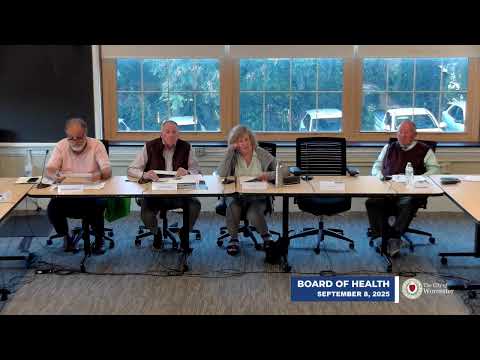
At the Worcester Board of Health meeting, staff summarized a new state requirement that standardizes local public‑health performance and sets mandatory reporting deadlines, and explained a capacity‑building grant for large cities.
Sherry Tangri, grant manager for Public Health Excellence (PHE) capacity building, said the change stems from legislation signed on Nov. 20, 2024, which codified the Blueprint for Public Health Excellence and is commonly abbreviated in the presentation as Safe2. Tangri said the statute makes compliance with performance standards and reporting requirements mandatory for all 351 municipalities.
Tamara Lundy, director of the Division of Public Health, told the board the law establishes defined roles for local boards of health and state agencies and requires annual reports demonstrating compliance. “These include inspections, epidemiology, communicable disease investigation and reporting, and local permitting,” Lundy said. She said annual reports must be submitted beginning in 2026, with an initial deadline noted by staff as August 31, 2026.
Tangri described the PHE capacity‑building funding stream that applies to larger cities. The grant — internally described during the meeting as the “large city grant” — is a standalone award for cities such as Boston and Worcester intended to raise workforce capacity, data tools and performance standards. Allowable uses included hiring public‑health staff, workforce development, and purchasing software or supplies to support performance improvements.
Board members asked how the state will collect data. Lundy and Tangri said the state will standardize reporting through systems such as the existing Maven communicable‑disease platform and a new inspections platform called Metrik (m‑e‑t‑r‑i‑k). Tangri said the state’s Office of Local and Regional Health would hold three virtual public hearings before November to solicit input; staff provided the board with the hearing dates (September 18, September 29 and October 8) and said the links appear in the presentation materials.
Lundy told the board that staff intend to present the specific performance workstreams and regular data reports to the Board of Health so board members can provide oversight and later sign the required annual report. No formal vote was taken; staff requested the board’s ongoing engagement and recommended dissemination of hearing information to stakeholders and residents.