Get Full Government Meeting Transcripts, Videos, & Alerts Forever!
Get email alerts on the Infectious Disease topic
No spam. Unsubscribe anytime.
Worcester health officials report jump in COVID cases, urge testing and mosquito precautions
Summary
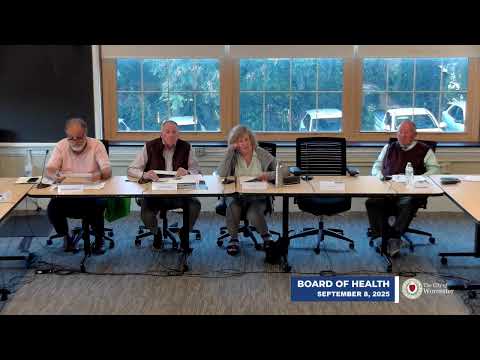
At a Worcester Board of Health meeting, city public-health officials said local COVID transmission has increased sharply and reviewed recent arboviral activity, including West Nile detections and a travel-related malaria case; officials urged testing, vaccination access for high-risk people and standard mosquito-bite prevention.
At a meeting of the Worcester Board of Health, city public‑health leaders reported a sharp rise in COVID-19 cases and highlighted recent arboviral activity, including West Nile virus detections and a travel‑related malaria case.
Amelia Houghton, chief of public health nursing, told the board that “COVID‑19 cases have tripled from the previous month,” and that influenza and salmonella have declined slightly. Houghton also noted a travel‑related malaria case and urged clinicians to collect travel histories in case investigations, citing CDC travel guidance commonly called the Yellow Book.
Dr. Michael Hirsch, medical director for the Division of Public Health, expanded on the COVID trend and gave practical advice for residents. “If you feel that you’ve been exposed or you feel like you have a flu‑like illness, it’s a wise thing to get an antigen test,” Hirsch said. He said people who test positive should avoid exposing others, consider masking for up to seven days after returning to activities, and that people at high risk (age 65 and older or those with serious medical conditions) should speak to their primary care provider about antiviral treatment such as Paxlovid.
Houghton said state surveillance identified thousands of mosquito specimens tested in Central Massachusetts this season. “There were over 7,600 specimens tested between June 15 and August 30 in Central Mass, Worcester County area,” she said, and confirmed West Nile virus samples were identified. She listed standard protective steps: repair window screens, use repellent between dusk and dawn, wear long sleeves and long pants at those times, use netting for infants and protect pets. She also noted that suspected animal cases of West Nile or other arboviral disease must be reported to the Massachusetts Department of Agricultural Resources, Division of Animal Health.
Hirsch cautioned that official federal vaccination guidance is in flux and varies by risk group. He said recent CDC guidance limits routine COVID vaccination recommendations mostly to older adults and people with certain medical risks, and that professional societies such as the American Academy of Pediatrics and the American College of Obstetricians and Gynecologists have pushed back to broaden access. “The recommendations coming out of the CDC are that only people over 65, or people younger than 65 with some of those comorbidities … should get [COVID vaccine],” Hirsch said. He added that in Massachusetts it remains possible for people who want a COVID shot to obtain one at pharmacies or through their providers, and the Worcester Department of Public Health has offered help to residents who encounter obstacles.
On other vector concerns, Hirsch described a conversation with a Tufts veterinary infectious‑disease specialist about screw worm reports in Texas and advised travelers and importers to avoid undercooked or imported meats from affected areas. He framed such threats as one example of how shifting climate and travel patterns affect infectious disease risks.
The board heard the update as an informational item; no formal action was taken. Officials said they will continue to monitor trends and provide updates to the public, and encouraged residents to follow standard protective measures against mosquitoes and to seek testing if symptomatic.