
Tompkins County housing officials warn many renters at risk as homelessness prevention expands
Get AI-powered insights, summaries, and transcripts
Subscribe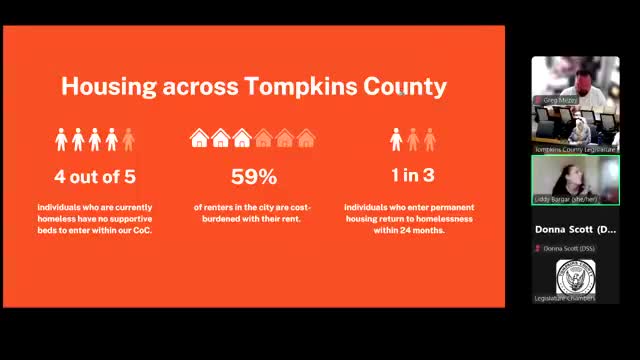
Summary
Human Services Coalition briefing to the Tompkins County Housing & Economic Development Committee described high rents, eviction pressure and limited supportive housing; county providers are piloting Medicaid 1115-funded prevention services to avert homelessness.
Liddy Barger, director of housing initiatives at the Human Services Coalition, told the Tompkins County Legislature’s Housing and Economic Development Committee on June 4 that rising rents and limited supportive housing are driving repeated entries into the county’s homeless response system.
"Four out of five people who are currently experiencing homelessness in our continuum of care do not have a supportive housing or other unit to move into," Barger said, summarizing local capacity shortfalls. She said 59 percent of renters in the City of Ithaca are cost-burdened, meaning they pay more than 30 percent of their income for housing.
The presentation placed those figures in context with area median income and fair market rent. Barger said 2025 area median income for a family of four in Tompkins County is $122,100 and used that to illustrate affordability gaps: "For somebody in that extremely low income, 30 percent area median income range ... the rent that they could reasonably afford ... would be $902 a month." She cautioned that real-world rents are higher and that many households cannot find units at those levels.
Barger described the frequency of eviction-related contacts and court activity: in 2024 local intake lines recorded 988 calls for eviction-related assistance; housing staff were able to provide some navigation or assistance to 162 callers. In the City of Ithaca there were 313 eviction court filings in 2024. She said most filings are nonpayment cases and that a small set of landlords account for a large share of filings.
On outcomes, Barger noted a durability problem: roughly one in three people who exit the homeless response system into housing return to the system within two years. She said the Human Services Coalition, housing specialists and partners are focusing more on upstream prevention rather than only on people already literally homeless.
To expand prevention, Barger described the county’s early use of New York State’s Medicaid 1115 waiver to pay for social care supports for Medicaid members at risk of homelessness. "The 11 15 waiver ... is designed to save money from emergency visits and other high-cost Medicaid things by meeting social care needs using Medicaid dollars," she said, and added that participating providers can bill for housing-related supports including up to six months of rental assistance, security deposits, and utility help.
Committee members asked for additional, comparative data. County Legislator Deborah requested median rent figures for one-, two- and three-bedroom units to compare with fair market rents and affordability calculations; Barger said she could provide or obtain more precise median-rent figures. Committee members also pressed for more detail on eviction trends by month and landlord concentration.
Barger and others emphasized limits on who qualifies for certain homeless-response resources: HUD definitions of literal homelessness determine eligibility for many programs, while the county is trying to serve people earlier in the risk continuum. The presentation relied on Homeless Management Information System (HMIS) intake data and local eviction filings to describe demand and capacity.
The committee did not take any formal votes related to the presentation; the briefing was informational and followed by questions from committee members.