
Tompkins County compiles 34 equity indicators; departments to report by strategic priority, county liaison named
Get AI-powered insights, summaries, and transcripts
Subscribe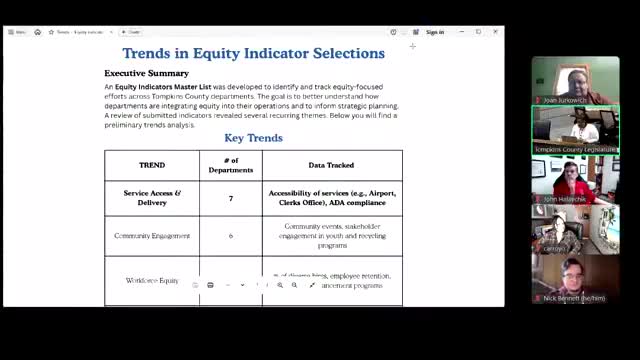
Summary
Chief Equity and Diversity Officer Charlene Holmes presented a baseline of 34 equity indicators aggregated across county departments and offered to serve as liaison between department heads and WDIC for periodic reports tied to the county’s strategic plan.
Tompkins County’s chief equity and diversity officer, Charlene Holmes, presented a countywide inventory of 34 equity indicators on May 28 and described early trends in how departments are tracking equity‑related activities.
Holmes told the Workforce Diversity and Inclusion Advisory Committee that the most common theme across departments is service access and delivery — departments are tracking accessibility, ADA compliance and outreach to ensure residents can use county services. "Our largest trend is service access and delivery, which is a complete alignment with our strategic plan," Holmes said.
Other frequent themes included community engagement, workforce equity (diverse hires, retention and inclusive advancement), procurement/equity in contracting, and leadership and accountability. Holmes said the indicators were self‑reported by department heads; almost all departments responded, with an aggregate distribution showing 8 departments selected one indicator, 13 selected two, and 1 selected three.
Holmes highlighted departments already tracking metrics: the Department of Social Services is focusing on equity training and internal groups; Facilities is tracking contract participation and workforce advancement collaborations; County Administration is monitoring training completion rates and policy alignment; Whole Health is implementing a demographic data toolkit; and Recycling and Materials Management is tracking equitable community engagement.
Holmes presented several opportunities for growth, including more strategic language‑access planning (LEP obligations), a unified approach to community outreach that reduces fragmentation across departments, and expanded indicators. The report will be folded into the county’s strategic plan reporting structure; Holmes said high‑level trends will be publicly available on the county site and that more detailed metric reporting will be integrated with the strategic plan’s KPI dashboard.
WDIC members accepted Holmes’ offer to act as a liaison between department heads and this advisory committee; Holmes proposed clustering departments by strategic‑plan priority and scheduling short presentations or one‑pagers so WDIC can review progress without overburdening staff. Committee members agreed to invite a small number of departments to present at future WDIC meetings.
Holmes said the master list is currently maintained internally by department heads and county administration; she also noted some departments have tracked indicators for about 18 months and that reporting maturity varies by department. The committee asked for a corrected count after a minor arithmetic discrepancy; Holmes confirmed there are 34 indicators in total.