Get Full Government Meeting Transcripts, Videos, & Alerts Forever!
Get email alerts on the Capital Improvement Plan topic
No spam. Unsubscribe anytime.
Committee recommends Salem FY26 Capital Improvement Plan, approves bond orders and related appropriations
Summary
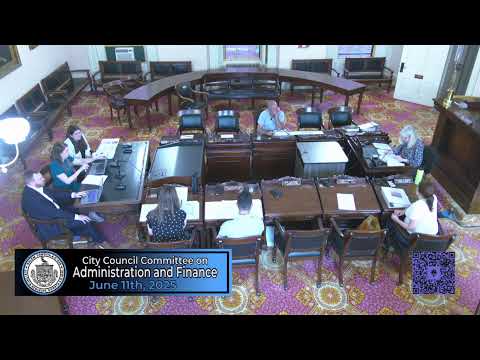
The Salem City Council Administration and Finance Committee, meeting as the Committee of the Whole on June 11, 2025, voted to recommend the city’s Fiscal Year 2026 Capital Improvement Plan and the proposed five‑year CIP and approved two capital bond orders to fund FY26 projects: a $10,026,020 general‑fund capital bond order and a $9,450,000 water and sewer capital bond order.
The Salem City Council Administration and Finance Committee, meeting as the Committee of the Whole on June 11, 2025, voted to recommend the city’s Fiscal Year 2026 Capital Improvement Plan and the proposed five‑year CIP and approved two capital bond orders to fund FY26 projects: a $10,026,020 general‑fund capital bond order and a $9,450,000 water and sewer capital bond order. Anna Friedman, Salem’s finance director, presented the bond orders and related appropriations at the meeting held in the council chamber.
The council order for the general‑fund bond appropriates $10,026,020 for FY26 capital projects and repurposes about $2.5 million in previously issued but unspent bond proceeds identified during a debt‑cleanup review. “We were able to identify over 2½ million dollars worth of unspent proceeds,” Friedman said, describing the repurposing as required to comply with federal IRS rules for the timing of bond proceeds and as a measure that will reduce future debt service for taxpayers. The remaining approximately $7.5 million in the general‑fund bond will be new borrowing.
The water and sewer bond order approves $9,450,000 for FY26 water and sewer capital projects. Friedman told the committee the staff identified roughly $196,000 in unspent water and sewer fund proceeds that can be applied to the FY26 borrowing, reducing new borrowing to a little over $9.2 million.
Committee members also approved multiple appropriations that fund one‑time capital projects and technical adjustments tied to the CIP package. Highlights:
- Short‑term CIP appropriations: The committee approved a short‑term CIP appropriation amended to remove a duplicate $26,000 line for police license‑plate readers after staff identified the item had already been included in the police department’s operating budget. Removing the duplicate reduced the short‑term CIP total from $5,703,457 to an amended $5,677,457; the $26,000 remains funded through the police department’s budget line. Councillor Stott moved the amendment; Councillor Harvey seconded it.
- Receipts reserved (golf course): The committee approved a $48,718 appropriation from the Receipts Reserved for Appropriation — Golf Course account to Parks & Recreation for purchase of a John Deere ProGator to be paid from user fees collected at the municipal golf course.
- Retained earnings (water/sewer): The committee approved a $689,938 appropriation from retained earnings in the water and sewer fund to FY26 water and sewer CIP projects, and approved a technical amendment to correct a written‑out numeric typo in the council order so the spelled‑out amount matches the numeric figure.
- Free cash transfer: The committee approved a $750,000 transfer from free cash into the short‑term capital fund to bolster funding for the FY26 capital projects included in the short‑term CIP.
- Short‑term rental (STR) housing and infrastructure fund: Under the local option in Massachusetts law that allows cities to collect a short‑term rental community impact fee, the committee approved using $200,000 from the STR housing and infrastructure fund to support traffic‑calming pilot projects. The STR program requires that those impact fees be used for capital investments; staff said roughly half of the fees have been treated as general‑fund revenue and half have accumulated in the restricted housing and infrastructure fund.
- Annual revolving funds: The committee authorized the city’s annual revolving funds ceilings for FY26 (the council order lists the revolving funds and their expenditure ceilings). Staff noted the sustainability and resiliency energy credit revolving fund has a higher ceiling this year to accommodate incoming credits that may be reinvested; departments must manage those ceilings carefully because overspending would be charged to the general fund.
After the individual votes on appropriations and amendments, the committee voted to recommend approval of the mayor’s letter submitting Salem’s FY26 Capital Improvement Plan and the proposed five‑year CIP as amended. Most motions were made by Councillor Stott and seconded by Councillor Harvey; the chair recorded unanimous support from the members present on each vote.
Why it matters: The bond orders fund major capital projects and the appropriations move one‑time and project‑specific funding into place for FY26. Staff emphasized that repurposing stale, unspent bond proceeds reduces future borrowing needs and taxpayer debt service; the city also used nonrecurring revenues (free cash and ARPA interest earnings) to limit new borrowing where practicable.
The committee’s recommendations will be forwarded to the full City Council for final action under the city’s legislative process.