Get Full Government Meeting Transcripts, Videos, & Alerts Forever!
Get email alerts on the Property Tax Levy topic
No spam. Unsubscribe anytime.
Coconino County staff recommend posting truth-in-taxation notices; propose modest levy increases despite lower county rate
Summary
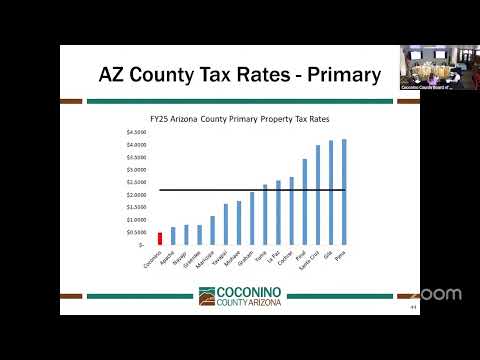
County staff recommended starting legal notices and scheduling a June 24 truth-in-taxation hearing for the general fund, public health services district and flood control district. The presentation noted Coconino County has the lowest primary property tax rate in Arizona; recommended levy increases translate to small median taxpayer impacts.
Coconino County staff recommended initiating legal notices for the county—s truth-in-taxation process and scheduling a public hearing on June 24 to set property tax levies for the general fund, the Public Health Services District and the Flood Control District, staff said at a Board of Supervisors budget meeting.
The recommendation follows budget work that would increase the county—s general fund levy by 2 percent on properties on the prior year roll while holding or reaching statutory maximums for two secondary districts. "This is a notice of a tax increase," staff member Siri said, explaining that the levy can rise even while the tax rate shown on the notice declines because assessed values have increased.
Why it matters: Coconino County currently has the lowest primary property tax rate among Arizona counties, staff said. Because values are rising faster than the allowable levy increase, the calculation produces a lower per-dollar tax rate while producing a larger levy in dollars. That algebra means the county expects modest additional revenue that officials called predictable and stable.
Staff presented the recommended changes in dollars and median impacts. For the general fund, the county—s current property tax levy is about $11,000,000; the recommended increase would add roughly $368,000. Staff estimated the median residential taxpayer—s bill for the general fund portion would rise about $2.10 under the recommendation.
The Public Health Services District is at its statutory maximum rate of $0.25 per $100 of assessed value, so staff recommended holding that rate; assessed-value growth and new construction would produce an estimated 5.7 percent levy increase (about $326,000) and a median taxpayer impact of $2.65. Staff noted the public health levy is restricted to health and human services uses and also receives a general-fund maintenance-of-effort payment (about $3.8 million annually).
Flood control is also at its maximum rate ($0.50 per $100). Staff proposed no rate change; assessed-value changes and limited new construction would increase the flood-control levy by about 5.5 percent (roughly $578,000). Staff gave a median taxpayer impact of $5.29 for the flood-control portion.
Taken together, staff estimated the combined median county taxpayer impact across the three levies would be about $10.04 (roughly a 3 percent change in total county levies for the example property used in the presentation). Staff emphasized that individual property impacts vary based on location, assessment changes and new construction.
Board members raised questions about the apparent contradiction between a "notice of tax increase" and a falling rate on the tax-rate line. "I'm having a hard time following this because it says in the truth in taxation, we're increasing. And then on the right, it's we're actually decreasing," Supervisor Vasquez said. Siri and other staff explained that the statutory notice language requires showing an increase in the levy in dollars; because limited assessed values rose by about 4.4 percent while the board is being asked to increase the levy by the 2 percent statutory allowance for existing properties, the computed rate declines even as the levy in dollars goes up.
Supervisors asked staff to make the public notice and any supplemental explanation clearer. "That paragraph of explanation goes a long ways," a board member said, urging a simple explanatory paragraph in the mailed/printed notice to reduce expected constituent calls. Staff said they could publish the statutory legal notice and include an explanatory paid supplement and web links with contact information for other taxing entities (for example, school and fire districts) that appear on the same tax bill.
Staff also flagged historical context: the board and staff described a past period when the county—s conservative use of taxing authority left it with a comparatively low rate and limited capacity; staff said that approach previously resulted in a restriction on rate-setting capacity. Arizona Tax Research Association (ATRA) engagement was described as part of ongoing outreach and review.
Next steps: staff recommended publishing the statutorily required truth-in-taxation legal notices, providing a plain-language supplemental explanation, posting materials online and holding a roll-call truth-in-taxation public hearing scheduled for June 24. At that hearing the board will open the hearing, take public comment, close the hearing and record individual roll-call votes on the levy items, staff said. No formal board adoption of the levies was recorded during this meeting.
The presentation also noted other taxing entities—not under the board—s control—appear on the same bill (school districts, fire districts) and that the county treasurer—s office issues consolidated tax bills; staff said they will supply contact information and links for other jurisdictions to assist taxpayers with questions.