Get Full Government Meeting Transcripts, Videos, & Alerts Forever!
Get email alerts on the Capital Improvements Budget topic
No spam. Unsubscribe anytime.
Nashville council adopts 2025–31 capital improvements budget, 29-0
Summary
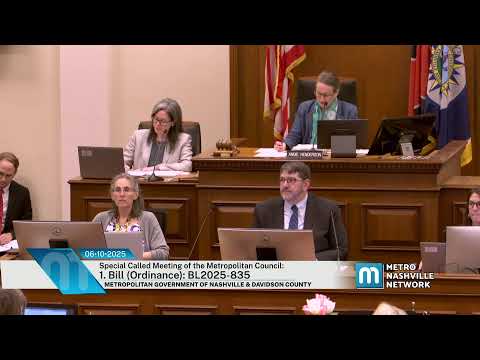
The Metropolitan Council adopted the 2025–31 Capital Improvements Budget (CIB) on final reading by a 29-0 roll-call vote. Council members and a public commenter debated priorities including pedestrian safety and proposals for publicly owned affordable housing, but no amendments were filed.
The Metropolitan Council of Nashville and Davidson County adopted the 2025–31 Capital Improvements Budget on final reading Tuesday, passing the ordinance 29-0 in a roll-call vote.
The ordinance (BL2025-835, sponsor Porterfield) was approved after committee reports showed unanimous support: the Budget and Finance Committee voted 11-0, and the Planning and Zoning Committee voted 9-0. Council members moved and seconded the ordinance on the floor and, after no requests to remove items from the proposed consent, the clerk recorded 29 votes in favor, none opposed and no abstentions.
The capital improvements budget is the city’s six-year planning document that prioritizes long-lived infrastructure projects. As discussed during the meeting, the CIB lists projects considered capital improvements when they have a lifetime greater than 10 years and cost more than $50,000. The council president noted the CIB process has evolved from what she described as a previously “meaningless wish list” into a more transparent, data-driven document; the council recorded that no amendments were proposed on final reading.
Public comment at the meeting focused on alternative uses of capital funds. Cade Wooten, a resident and public commenter who identified himself as representing District 6, urged the council to use the CIB to expand “community centers, affordable housing, and transit hubs” and to prioritize “publicly owned, permanently affordable, non-market social housing.” Wooten said, “Housing should be a human right and not a commodity,” and urged the council to design co-located hubs that pair housing with childcare, food access and transit services.
Several council members also tied the CIB discussion to street-safety investments. Councilman Coopin, addressing the chamber by personal privilege, spoke about a recent pedestrian fatality in Germantown. He described the victim, Dot Dobbins, as “a neighbor, the best kind of neighbor,” and said she was struck and killed while using a marked crosswalk. Coopin said the incident underscores ongoing needs for pedestrian, bicycle and road-safety improvements and noted the Nashville Department of Transportation is working on measures in the area.
Committee chairs formally moved for approval on the floor. The clerk confirmed all committee reports were filed, after which the council conducted the required roll-call vote. The ordinance now stands adopted as the official CIB for fiscal year 2025–26 through 2030–31.
The council also approved eight other ordinances (agenda items 2–9) on consent; those measures had unanimous committee support and were passed without separate debate. The meeting was adjourned with the council scheduling its next session for June 17.