Get Full Government Meeting Transcripts, Videos, & Alerts Forever!
Get email alerts on the Shelter Classification And Outcomes topic
No spam. Unsubscribe anytime.
Advocates and officials clash over classification and outcomes at Roadway Inn after Old Tent City closure
Summary
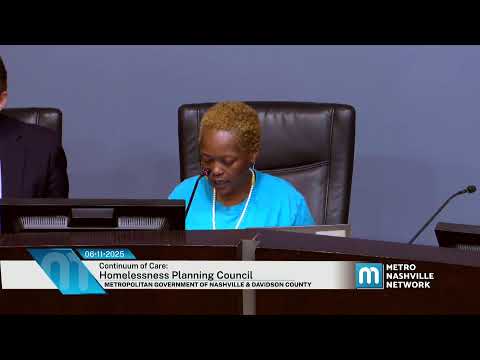
At the Homelessness Planning Council meeting in June, a public commenter and council members pressed Office of Homeless Services staff about whether people moved from Old Tent City to the Roadway Inn should be described as "housed," how the site is classified in HMIS, and what on-site services and timelines look like.
Shanley Degnan, chair of the HMIS Oversight and Data Committee, told the Homelessness Planning Council that she was "uncomfortable using the phrase housing in this way" when the Office of Homeless Services (OHS) reported 107 people were connected after the Old Tent City encampment and that 81 of those people were staying at the Roadway Inn.
Degnan said the Roadway Inn has no kitchens in rooms, rules such as bag checks and curfews, and — crucially for federal reporting — the project type in HMIS is set up as an emergency shelter. She asked the council to update public-facing language and to break out outcomes by shelter type so funders and planners know how many people moved into permanent housing versus temporary shelter.
The issue matters because how the community describes and reports placements drives resource requests and performance measures. Degnan said the public report that lists 107 housed could be misread as permanent housing placements; she urged the council to distinguish emergency shelter placements from interim or permanent housing in its reports to preserve clarity with local and federal funders.
Director Calvin of the Office of Homeless Services responded that HUD technical assistance helped design an "interim housing" model used locally and that the Roadway Inn was intentionally set up to provide on-site services and meals. Calvin said the HMIS database lacks an "interim housing" drop-down, so the Roadway Inn is recorded in HMIS as an emergency shelter even though the community uses the term "interim housing" in planning and service delivery. "The interim housing, it is a option of housing," Calvin said, and she emphasized the community goal of moving people into permanent housing.
Calvin told the council that, historically, when the community has used similar interim models, 88 percent of participants did not return to homelessness and roughly 66–67 percent of that group later moved into permanent housing. She described on-site services at Roadway as including meals, housing navigation and case management, and partnerships with providers such as Neighborhood Health and Hospitality Hub. She said average stays aim to be about 90 to 120 days, shorter for church-conversion options and longer for some hotel conversions.
Council members and other committee members pushed for clearer, longitudinal data. One member asked for reporting of outcomes at 30, 60 and 90 days specific to Roadway so the council could better understand length of stay and where people go afterward. Degnan reiterated that federal reporting and public messaging should align: "We actually need, you know, 100 plus housing resources for this encampment, not we've already housed 107," she said, arguing for separate tallies for emergency shelter placements and permanent housing moves.
Several speakers also raised operational and rights concerns. Questions included whether residents have leases, what grievance or notice procedures are available if someone is asked to leave, what kinds of security are used and whether on-site security has received complaints. Calvin said OHS has requested the provider's policy and grievance procedures and meets with the operator regularly, and that the security team on site has experience with the unhoused population and that operators and police coordinate quarterly meetings when possible.
The council did not take a formal vote on classification language at the meeting but multiple members asked staff to supply follow-up materials: the HUD technical-assistance rationale for the term "interim housing," HMIS classification guidance, the operator's grievance procedures, and longitudinal outcome reports for Roadway at 30/60/90 days.
Ending
Council members asked OHS to return with clearer, aligned language for public reports and with longitudinal outcome tables for Roadway placements so the Homelessness Planning Council and funders can better distinguish emergency shelter placements from permanent housing exits. OHS agreed to provide the HUD TA explanation, operator policies, and additional outcome reporting for future meetings.