
Sun Prairie Area School District presents new three-year strategic communications plan
Get AI-powered insights, summaries, and transcripts
Sign Up Free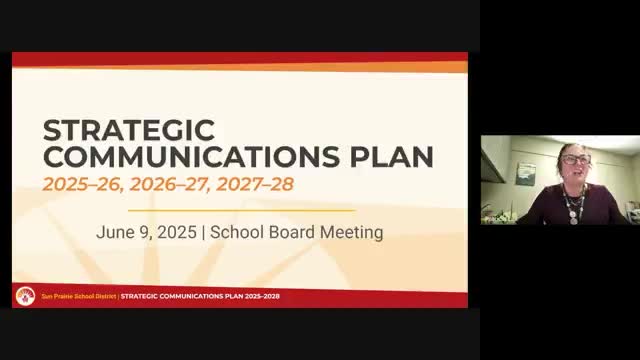
Summary
District communications leaders presented a new three-year strategic communications plan to the school board, citing a communications audit, more than 1,000 survey responses, student focus groups and a communications committee; next steps include summer 2026 implementation of selected tactics and a website redesign targeted for 2026.
Patty Lux Milsna, director of communications and engagement for the Sun Prairie Area School District, and Adam Mumm, the district's multimedia and website strategist, presented a new three-year strategic communications plan to the school board, summarizing findings from an audit, a districtwide survey of more than 1,000 respondents, and student focus groups.
The plan follows the district's Operating Expectation OE-9, which the presenters said requires a communications plan, and aims to align district communications with community expectations while advancing equity. "We are here today to share with you how we created a new 3 year strategic communications plan," Lux Milsna said.
The communications audit included an inventory of tools and analytics, the previous 2022'2025 communications plan, and a survey of families, staff, high school students and community members. Presenters said the survey produced a statistically significant sample for the district and yielded baseline measures the plan seeks to improve: the audit showed a 69% positive impression of the district and 61% of respondents said they feel they can easily share perspectives with the district.
From the audit and committee input, the communications committee identified themes that became eight strategic priorities in the new plan: ensure accessibility and equity; build and sustain trust; deliver relevant, personalized communications; strengthen two-way communication and engagement; connect the community to schools; elevate internal communications and employee engagement; strengthen communications training and strategy; and build family engagement and belonging.
Mumm said tactics for each priority are organized with action steps, evaluation measures and timing across the three-year cycle using the public-relations framework RPIE (research, planning, implementation and evaluation). "We went through each tactic and determined based on strategy and feasibility where it would make sense to do it, and we divided it into each of the next 3 years into summer, fall, and spring," he said.
Specific audit findings and next steps noted by the presenters included an intent to streamline district communications to reduce overlapping messages and prioritize direct communications from teachers and school newsletters, a planned website redesign targeted for 2026 to address modern design and accessibility requirements, and efforts to increase two-way engagement so more community members feel heard. The presenters also said they worked with the International Association for Public Participation (IAP2) and reviewed best practices from WISPRA and NSPRA while developing the plan.
The presenters described the committee process as collaborative and ongoing: a communications committee made up of staff, at least one principal, a student and community members met multiple times and will continue to advise implementation. Lux Milsna and Mumm said summer 2026 strategies will be the first to be implemented and that staff will bring updates back to the board; Mumm noted they will be at the board meeting on June 9 to continue reporting to trustees.
No board vote or formal action was recorded in the presentation; the meeting item was a staff briefing and set out implementation steps rather than a board decision. The district provided links to the audit report and the prior 2022'2025 communications plan in the board packet for members seeking more detail.
Supporters of the plan and the presenters highlighted equity as a throughline of the strategy and said measurable objectives will be used to evaluate progress. The presenters also emphasized continuing to expand two-way channels and co-create engagement strategies with families from historically underserved communities.
Next steps listed by the presenters include beginning implementation of summer 2026 tactics, continuing to work with the communications committee for advisory support, and tracking progress via the plan's stoplight monitoring approach.