Get Full Government Meeting Transcripts, Videos, & Alerts Forever!
Get email alerts on the Detention Facility Budget Staffing topic
No spam. Unsubscribe anytime.
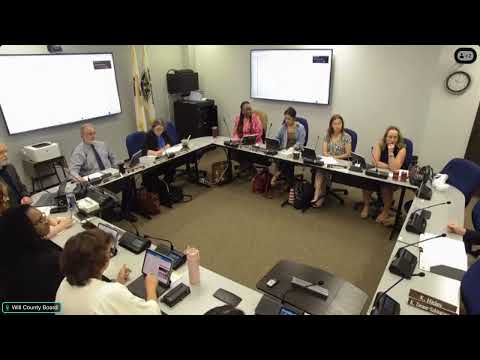
Will County sheriff—s chief deputy details detention facility budget, staffing and accreditation challenges
Summary
Chief Deputy Jay Adams told the Will County Health and Public Safety Committee the Adult Detention Facility came in under its original budget, but faces near-term staffing retirements, equipment replacement needs and a change to inmate-funded programming after a recent FCC ruling.
Chief Deputy Jay Adams told the Will County Health and Public Safety Committee on the department—s Adult Detention Facility that the jail spent less than its original county-approved budget last year but faces equipment upgrades, an upcoming wave of retirements and potential loss of inmate-funded programs because of a Federal Communications Commission ruling.
Adams, who said he goes by Dave, summarized the facility—s 2024 revenues and expenses and described day-to-day operations, training and conditions that county officials said matter for safety and budgeting decisions.
Adams told the committee the county originally budgeted about $51,600,000 for the detention facility, revised the number to about $50,800,000 and "we actually came in $155,000 under the original budget," noting lower overtime and steady hiring as cost drivers. He described several small revenue categories: about $600 in one-off housing reimbursements, roughly $72,500 in Corrections Academy reimbursements from the state, a $112,000 SCAP Department of Justice grant for housing criminal aliens and other modest recoveries.
"The rest of the revenues that we get are budgeted by you members, approved by you," Adams said. He also reviewed the inmate trust account, which he said is funded by inmate services such as commissary, video visits and telephone commissions and is used only for inmate-benefit items such as recreation equipment and televisions. "Everything we spend out of it goes to benefit the inmates," he said.
Adams described the facility as a direct-supervision jail with "pods" rather than rows of cells and said the operation relies on intensive training: two weeks of facility orientation, eight weeks at the Basic Corrections Academy, one week of direct-supervision instruction and nine weeks of field training. "That's how we prepare an officer," he said.
He outlined capital needs that have been addressed and others that are pending. The jail recently replaced a long-leaking roof and plans to begin a multiweek upgrade of the door-control and integrator system because replacement parts are no longer sold for the existing components. "We were actually, for a long time, buying replacement network cards and things like that on eBay," he said.
On staffing, Adams warned of many eligible retirements: about 21 employees eligible by the end of this year, nine more in 2026 and 15 in 2027. "So that's a total of 45. And then by 02/1930, we'll have 77 eligible to retire," he said. He cautioned that eligibility does not guarantee retirement but said the numbers present a planning challenge for the county. Adams also explained the facility—s current shift structure and why a switch to 12-hour shifts for deputies is not immediately feasible: "We have minimum staffing requirements and so ... I can't have 1 deputy cover 100 inmates," he said, noting the average general-population housing unit "has about 50 inmates and 1 officer." He added the department is exploring 12-hour shifts for supervisors this fall as a pilot.
Adams raised a policy and funding issue stemming from a recent FCC decision that, he said, prevents counties and states from receiving a share of revenues generated by inmate communications. "The FCC has ruled that the companies that provide the services for the inmates ... can still generate revenues and make a profit, but the counties and the states can no longer have any funds out of that," Adams said. He told the committee that items now paid for from inmate communications and commissary funds—such as law-library subscriptions and services provided by the Center for Correctional Concerns—may need to be reduced or subsidized by county taxpayers going forward.
Committee members asked for additional information. Adams said he would provide the average length of stay and related metrics by the end of the day. Committee member Jackie Mitchell proposed sending the matter of staffing and salaries to the Finance Committee for further budget discussion; Committee member Berkowitz and others also asked for follow-up information on accreditation, insurance and capital needs.
Adams closed by noting the facility holds both medical and mental-health care, including medication-assisted treatment, and reiterated staffing, aging equipment and changes to inmate-funded revenue as the principal near-term concerns.
The committee did not take a formal vote on policy changes; members directed staff and the sheriff's office to supply additional documents and to bring staffing and budget questions to the Finance Committee for a deeper review.