Get Full Government Meeting Transcripts, Videos, & Alerts Forever!
Get email alerts on the Facility Funding topic
No spam. Unsubscribe anytime.
Board reviews Construction Excise Tax revenue, $2.1M balance and options for long-range use
Summary
District finance staff reviewed the Construction Excise Tax (CET) program, explained allowable uses, reported a roughly $2.1 million CET fund balance and raised the possibility of increasing the CET rate under state indexing rules.
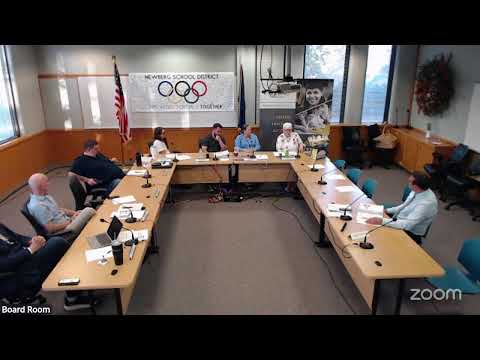
District finance staff briefed the Newberg School District 29J board Tuesday on the Construction Excise Tax (CET) revenue stream, how the district has used the funds since creating a dedicated CET fund in 2015, and ways the board could plan for future capital needs.
Nathan, the district’s director of finance, summarized the CET as a locally collected fee on new construction intended to help pay capital costs not covered by state school funding. “There is a tax assessed on new residential and commercial construction, that brings a small amount of money, into districts to help offset some of those costs that aren't designated funding stream,” Nathan said as he described the program.
He outlined the CET mechanics discussed in state law: a $1-per-square-foot charge for residential and $0.50 per square foot for commercial construction established by Senate Bill 1036 in 2007, with a maximum cap per permit and later indexing authorized by the legislature. Nathan reported that the district’s CET fund balance is about $2,100,000 and noted revenue fluctuates with local permitting activity (years such as 2018 and 2022 showed larger receipts).
Board members asked procedural and timing questions about the revenue (for example, whether CET receipts follow the district fiscal year and whether permits are assessed at the time a permit is paid). Nathan said receipts are recorded in the district’s regular fiscal year and are based on permit payments to municipalities.
The board discussed using CET dollars both for known, recurring capital needs—such as turf replacement on an approximately 10-year cycle—and for unplanned emergencies (for example, building flood repairs or major HVAC replacements). Nathan recommended aligning CET planning with the district’s long-range facilities plan and noted the district has not adjusted the CET rate since adoption; he said the statutory index could raise the rate and that neighboring districts levy higher amounts.
No change to the CET rate was enacted; the presentation was informational and board members asked the finance office to return with comparative rates from other districts and with options for reserving CET revenue in targeted “buckets” for expected future projects.
Nathan said staff will return with recommendations as part of strategic and facilities planning so the board can decide whether to increase the CET rate, reserve annual amounts for predictable capital replacement, or retain the balance for emergency use.