Get Full Government Meeting Transcripts, Videos, & Alerts Forever!
Get email alerts on the Budget topic
No spam. Unsubscribe anytime.
District outlines 2025—26 budget assumptions, enrollment trends and multi-year projection; warns of reserve drawdown
Summary
Rescue Union Elementary presented its June budget update on June 10, using a 2.3% COLA assumption for 2025—26, and warned trustees the district expects to draw on reserves while preserving a board-required 10% minimum.
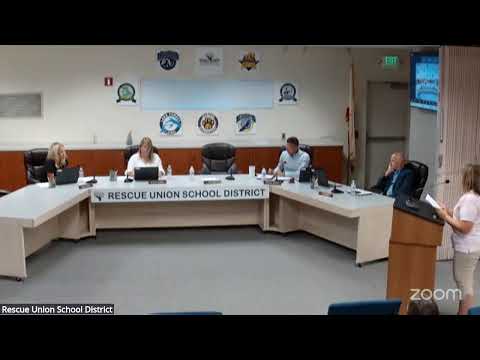
The Rescue Union Elementary School District held a public hearing on its 2025—26 budget on June 10. Lisa Donaldson, Assistant Superintendent of Business Services, presented a June update for closing fiscal year 2024—25 and the proposed 2025—26 budget assumptions.
Key fiscal assumptions and changes: the district reported higher-than-expected attendance (P-2 attendance) for 2024—25 that yielded roughly $128,000 in additional LCFF funding for the year. The May revise provides an estimated statewide COLA of 2.3% for 2025—26, which the district used in its projections. The district told trustees it expects some one-time state discretionary dollars to be smaller than earlier projected and that some onetime funding may be deferred by the state.
Enrollment and attendance: staff presented cohort and kindergarten enrollment trends that show a modest decline in incoming kindergarten cohorts compared with prior years. The district forecast a near-flat enrollment for 2025—26 (an estimated decrease of eight students) and modest declines in subsequent years; staff said projections err on the conservative side and will be updated after summer enrollments.
Multi-year outlook and reserves: the district presented a multi-year projection that shows deficit spending of roughly $750,000 in 2024—25 and about $2,000,000 in 2025—26 under current assumptions. Donaldson said the district will use reserves to cover the shortfalls but is projecting to remain at or above the board's 10% minimum reserve at the end of the three-year window. The district described the ending fund balance in 2027—28 as representing roughly two months of payroll to emphasize the cash-flow meaning of the reserve level.
Capital, program and other highlights: the district moved a bus purchase and some capital expenditures from 2024—25 into 2025—26 because vehicles were delayed; staff said one wheelchair-accessible bus is expected to be in service by October. The district reported shifting a bus order from one manufacturer to another after canceling an agreement with the original vendor; the earlier electric-bus purchases and vendor issues were discussed elsewhere in the meeting. The district also said it is transferring an estimated solar savings amount annually into the capital improvements fund (a 25-year average transfer the presentation cited as $500,000) and that actual annual savings vary year to year.
Grants and staffing: the budget includes planned use of a wellness coach grant and funding for two PBIS facilitators at specific sites; the district said those positions are grant-funded initially and could be documented for reimbursement if certain county-level youth behavioral health initiatives become available. The proposed 2025—26 budget also includes tentative agreements (approved in the same meeting) for bargained groups and unrepresented employees.
What the board heard and next steps: trustees had questions about state-level budget uncertainty, deferred payments and the length of reserves. Donaldson said that while the near-term out-year projections show deficits, the district has buffers and plans to keep its 10% policy minimum and will monitor changes from the state budget, enrollment, attendance and negotiations. The budget and related LCAP were scheduled for adoption at the June 17 meeting.
Ending: The hearing was informational; the board did not take adoption action on June 10. Staff will return with the adopted budget and required local indicators report at the next regular meeting.