Get email alerts on the Comprehensive Plan topic
No spam. Unsubscribe anytime.
Franklin County finalizes countywide planning policies draft ahead of comprehensive-plan hearing
Summary
County planners presented a final draft of countywide planning policies that set housing allocations, urban growth guidance, annexation principles and resilience measures; the board and cities will use the policies as the basis for interlocal agreements and later implementation steps.
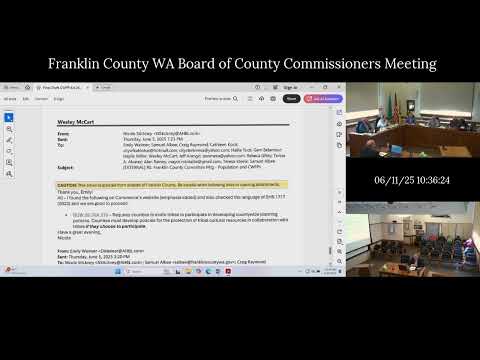
Franklin County planning director Wes McCart presented a final draft of countywide planning policies during the board's June 11 workshop, asking commissioners to flag any issues before the county forwards the document for hearings.
McCart said the policies “describe how the counties will work together” and emphasized state-mandated changes, including greenhouse gas measures and new housing requirements. “We are required to provide for housing across all of the different income levels,” he said.
The draft sets population-growth assumptions (moderate-to-medium growth, McCart said), allocates most new housing capacity to Pasco and its urban growth area, and limits allocations to Mesa and Colotus because those communities are projected to remain stable. The draft also adds policy language about climate resilience, shoreline integration, and legal as well as physical availability of water following recent court precedent, McCart said.
Commissioners focused discussion on annexation and urban-growth-area (UGA) management. McCart said the policies are intended to foster “consistency” across jurisdictions, not identical rules, and to reduce piecemeal annexations and “donut-hole” road‑jurisdiction problems by encouraging clearer boundaries and interlocal agreements. He described interlocal agreements as the likely next step to implement policies and to coordinate standards, utilities and road responsibility between the county and cities.
McCart also said the county had invited federally recognized tribes to participate in the planning process, but he reported no tribal responses at this point. He advised commissioners that the policies are high-level and not intended to substitute for local development codes.
The board did not take a formal vote at the workshop; McCart asked commissioners to identify any substantive changes before the item returns for formal action and public hearing.
The draft will be shared with cities and other jurisdictions for further review and interlocal-agreement negotiations before adoption and implementation steps are scheduled.
AI generated
The text on this page is AI generated. Summaries, highlights, analysis, and video transcripts are all produced from the original source material.
AI can make mistakes, so if you spot one, and we will fix it for everyone.
Note: the source content is unaltered by us. Any content source we link to, be it a video, an audio recording, or a document, is presented exactly as its publisher released it. That publisher is usually a government body, sometimes an individual official or another organisation.