Get Full Government Meeting Transcripts, Videos, & Alerts Forever!
Get email alerts on the Gas Infrastructure Leaks topic
No spam. Unsubscribe anytime.
Committee presses Eversource for detailed gas-leak report after Grade 1 repair on Burncoat Street
Summary
Committee members questioned Eversource about gas leaks in Worcester, including a April incident at 85 Burncoat Street that the company initially classified as Grade 2 and later as Grade 1; the committee requested a detailed report mapping Grade 1–3 leaks, repair status, costs and proximity to sensitive sites and voted to file one order and hold a
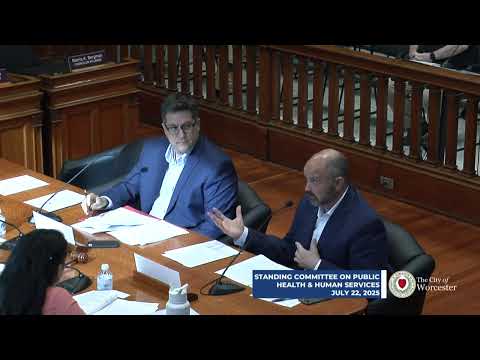
Worcester Public Health and Human Services Committee members pressed Eversource representatives on the city’s incidence of gas leaks and sought a detailed report on Grade 1, 2 and 3 leaks, repairs and maps showing leak locations and proximity to sensitive sites such as schools and parks.
The request stemmed from an April incident near 85 Burncoat Street that Eversource said was first investigated as a Grade 2 and later reclassified as a Grade 1, prompting an immediate excavation and repair. Councilor Hunter and other committee members said they wanted more data on the number of open leaks, repair timelines, environmental impacts and cost implications for ratepayers.
Mike Kane, Eversource community relations, and Brian (Bridal) Gillis, director of operations for Eversource in the presentation, told the committee the company had limited time to prepare but offered an overview. Gillis said the Burncoat Street location produced an initial Grade 2 reading on April 1 after a member of the public reported an odor. The company monitored the site and, after a follow-up call on April 28, said it recorded readings that crossed the Grade 1 threshold and “we excavated that that evening. Went into the evening. Finished up into the early morning,” and crews installed a clamp and encapsulated a bell joint to secure the leak.
Eversource staff explained the grading system for leaks: Grade 1 requires immediate repair because the leak poses an emergency risk to life or property; Grade 2 has a one-year compliance date with six-month monitoring; Grade 3 requires annual monitoring but no mandated repair date. Gillis said a small change in measured gas readings between the first and second investigations — cited as a movement from below to above a five-percent threshold on a panel — led to the reclassification.
Eversource also provided system context: about half of Worcester’s gas mains are what the company classifies as “leak-prone” pipe (cast iron or bare steel) — roughly 170 miles — and the company described state-level and federal programs (including Gas System Enhancement Plans, GSEP) that fund and prioritize replacement of older pipe. Company slides, shown to the committee, indicated declining leak rates in their service area since GSEP efforts began in 2014.
Committee members raised several concerns: Councilor Hunter and others asked whether leaks cause unrecovered costs passed to ratepayers; Gillis said that while the company estimates roughly 3% of gas is “lost and unaccounted for” systemwide, only about 0.06% is attributable to leakage in their accounting, and that lost gas from third-party strikes or underground releases is part of that unaccounted-for figure. Councilor Toomey asked for clarification on repair technique and scope; Gillis described excavating to the leak, cleaning the adjacent pipe, and applying a clamp or replacing a section when necessary.
Members asked Eversource to provide a more detailed packet and return to the committee. Specific requests included: a map of Grade 1–3 leak locations in the city over the past two years; counts of leaks by grade and repair status; cost estimates or dollar equivalents of leaked gas where possible; the number of leaks occurring near schools and other sensitive sites and response times for those incidents; and data produced by the Homeless Management Information System (HMIS) and Continuum of Care where relevant to outreach programming (for the HUD item cross-reference).
The committee agreed to file Order 4A and hold Order 4B (the order seeking the same report produced with Eversource) for a future meeting so staff and Eversource can return with the requested, more detailed data and mapping. Chair Councilor Luis Ojeda and committee staff said they will coordinate scheduling and report content.