Get Full Government Meeting Transcripts, Videos, & Alerts Forever!
Get email alerts on the Human Trafficking topic
No spam. Unsubscribe anytime.
Michigan State Police urge wider vigilance, trucking partnerships to spot human trafficking
Summary
Michigan State Police officials told a House Oversight subcommittee that increased awareness, Truckers Against Trafficking training and interagency partnerships are key tools for identifying and helping human trafficking victims across the state.
Investigator Chad Schmidt and Sergeant Christina Droste of the Michigan State Police told the Michigan House Oversight Subcommittee on Homeland Security Foreign Influence on the committee’s floor that awareness and targeted outreach — especially in the trucking and busing industries — are central to identifying and helping victims of human trafficking.
The presentation emphasized that trafficking occurs in plain sight in Michigan communities and urged lawmakers to support training and evidence rules that make prosecution and victim services more effective. Sergeant Christina Droste, legislative liaison to the Michigan State Police, and Investigator Chad Schmidt, statewide coordinator for Truckers Against Trafficking within the department’s Commercial Vehicle Enforcement Division (CVED), described outreach efforts, training materials and partnerships with nonprofit and law-enforcement task forces.
Nut graf: The Michigan State Police asked lawmakers to keep awareness and victim-centered policy as priorities, pointing to Truckers Against Trafficking (TAT) outreach and state task forces as key lines of defense. Committee members pressed presenters on cooperation with federal immigration enforcement, school-based education and sentencing outcomes in local prosecutions.
Schmidt, who coordinates the CVED’s TAT work, told the committee that the trucking community is uniquely positioned to spot indicators of exploitation because truck drivers and carriers travel widely and see patterns across corridors. "Human trafficking is a lot like the elephant in the room," Schmidt said. "It's something so large that takes so much work and energy to move around pretending like it's not actually there." He and Droste described TAT materials — pocket cards, decals and an app — and said the CVED has delivered dozens of presentations to carriers and community groups.
The presenters gave several statistics to illustrate scale and local contacts: they said the National Human Trafficking Hotline (888-373-7888) is available 24/7; they cited roughly 11,000 hotline contacts in Michigan that identified about 3,307 cases and 6,909 victims. Schmidt also offered global and national estimates, which he described as difficult to quantify given the clandestine nature of the crime.
Committee members asked how the state police work with other agencies. Schmidt and Droste described partnerships with the Michigan Human Trafficking Commission, the attorney general’s Human Trafficking Initiative, local sheriff offices and a district-level trafficking and abduction task force. They said CVED officers operate under commercial-vehicle enforcement authority and can investigate, coordinate with task forces and make stops when a commercial-vehicle law or probable cause exists, but that constitutional limits on searches and detentions restrict what officers can do without additional probable cause.
Representative Rob Shriver pressed whether the Michigan State Police would coordinate more directly with U.S. Immigration and Customs Enforcement (ICE) to address trafficking tied to cross-border movement. Schmidt responded that the department prefers a victim-centered approach that emphasizes resources and rehabilitation rather than shifting focus to victim status. "The way I would prefer to focus our victim approach is to provide resources and rehabilitation services to victims and not to blame them for their circumstances," he said, adding that traffickers will shift victim populations if one subset is removed.
Several lawmakers asked about school-based education and public messaging. Schmidt and Droste said CVED and partner groups provide outreach but could not point to a single, statewide K–12 program; they encouraged broader community awareness and noted ongoing efforts to place materials in truck stops, safety meetings and new-hire trainings within transportation agencies. The presenters said MDOT discussions were underway about adding trafficking awareness to certain training modules.
Lawmakers also raised sentencing and evidentiary questions. Schmidt noted that recent legislative changes (he referenced a package that included Senate bills 515–517 and a prior session’s hearings on evidentiary rules) have helped investigators and prosecutors, and he encouraged revisiting bills that provided safe-harbor provisions, tailored evidentiary rules and expungement pathways for victims. He said the department supports legislative fixes that make prosecution more effective but does not take positions on specific sentence lengths.
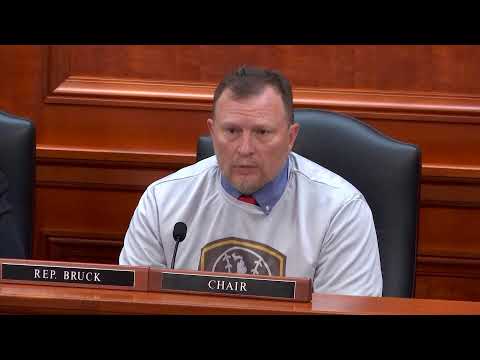
The committee did not take formal action during the presentation. Chair Brock thanked the presenters and said the committee would consider legislative follow-up this session.
Ending: Committee members expressed visible emotion after the presentation and discussed continuing conversations with the department and other state agencies about training, legislative changes and further outreach to trucking and school communities.