Get Full Government Meeting Transcripts, Videos, & Alerts Forever!
Get email alerts on the Blue Oval Battery Project topic
No spam. Unsubscribe anytime.
Lawmakers Question State Incentives for Ford’s Blue Oval Battery Project and Ties to CATL
Summary
Michigan Economic Development Corporation officials told a House oversight panel that state incentives support Blue Oval Battery Michigan, a Ford-owned entity, while lawmakers and witnesses raised national security and transparency concerns about CATL’s role and the project’s incentive package.
State economic development officials told a Michigan House oversight panel on June 4 that the state’s financial support for the Blue Oval Battery campus in Marshall is contracted solely with Blue Oval Battery Michigan, a Ford-owned entity, but lawmakers and outside witnesses pressed officials about licensing ties to Chinese battery maker CATL and the transparency and security of incentive arrangements.
Kristen, a Michigan Economic Development Corporation (MEDC) representative, told the House Oversight Subcommittee on Corporate Subsidies and the House Committee on Homeland Security and Foreign Influence that “this project at the major campus in Marshall is with Blue Oval Battery Michigan, which is an entity wholly owned by Ford. This is not a joint venture.” She added that “no public money has been nor will be awarded to CATL through this project.”
The discussion centered on the structure and size of state incentives, how those incentives changed after Ford resized the project, and whether downstream contracts or licensing with CATL — Contemporary Amperex Technology Co., Limited — present national security risks. Josh, another MEDC representative, said the state has not yet disbursed grant dollars and that “the grant is very specific on what those grant dollars can be used for” and that licensing fees or payments to CATL are not eligible for reimbursement under the grant.
Why it matters: The project is among the largest economic-development investments in Michigan in recent years. MEDC officials told lawmakers the Michigan Strategic Fund (MSF) approved a Critical Industry Program (CIP) grant in February 2023, the Legislature appropriated funds in April 2023, and the MSF approved amendments in July 2024. Under the amended CIP agreement, Blue Oval Battery Michigan may receive up to $141 million in reimbursements if it creates at least 1,700 qualified jobs and invests $2.5 billion by March 31, 2028; the company could earn up to $166 million if it reaches 2,100 jobs and $3 billion in investment.
MEDC officials outlined other public funding tied to site readiness and infrastructure: a Strategic Site Readiness Program (SSRP) allocation that totals roughly $185.3 million (including $120.3 million to support the Blue Oval site), a legislative appropriation of $299.7 million to support surrounding site development, and a $330 million direct appropriation to the Michigan Department of Transportation (MDOT) for road improvements. MEDC said its REMI (Regional Economic Models, Inc.) analysis estimated a $1.21 net tax return for every $1 of state incentives and forecasted about $24.9 billion in new personal income tax over 20 years based on the project’s revised scope.
Lawmakers and witnesses pressed MEDC about CATL’s role and national security implications. Vice Chair Green and Representative Sherbrooke asked whether MEDC has responsibility for downstream contracting when state funds go to Blue Oval and Blue Oval contracts with vendors. MEDC answered that the agreement restricts eligible uses and that the state reimburses hard construction costs; MEDC said the jobs counted toward the performance milestones must be Blue Oval or Ford employees.
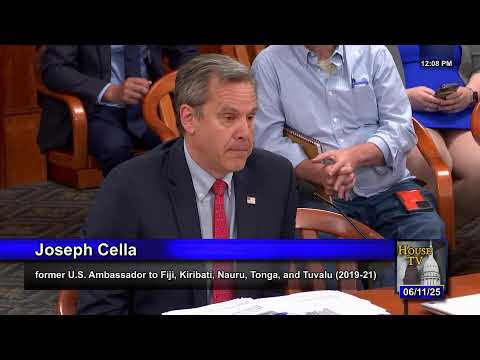
Former U.S. Ambassador Joe Sella, co-founder and director of the Michigan China Economic and Security Review Group, told the committees he views CATL as “deeply tied to the Chinese Communist Party” and called the arrangement “a grand high-tech and manufacturing high-risk experiment settled on the back of Michigan taxpayers.” Sella and several lawmakers referenced federal actions and national security reviews: Department of Defense and Department of Homeland Security steps regarding CATL and references to CFIUS (Committee on Foreign Investment in the United States) and the National Defense Authorization Act were discussed as possible mechanisms for review.
Areas of contention and clarifications: MEDC said it restructured the incentive package after Ford downsized the project and raised the starting base wage to $25 an hour (about $5 more than the originally approved starting wage and above the Calhoun County regional median wage cited at $21.52). MEDC said it maintains a security interest in grant-related deposit accounts and that the grant includes performance milestones and repayment provisions if the company does not meet job or investment commitments.
MEDC also said the state is funding road and site work, that MDOT controls the $330 million in appropriated road funds, and that MDOT is conducting NEPA (National Environmental Policy Act) studies for several highway and interchange improvements expected largely complete by 2027. MEDC described community benefits reported by Ford, including more than $450,000 in community investments and tree plantings and noted more than 1,300 housing units proposed or completed in the area since the announcement.
What the hearing did not resolve: Committee members asked whether a CFIUS review had been done; MEDC said that CFIUS is not a process the agency runs and that it would follow up. Lawmakers also asked for deeper public documentation of the REMI model inputs and assumptions; MEDC said the REMI analysis accounts for incentives and regional economic dynamics and offered further briefings. Multiple legislators asked whether alternative non-China-affiliated suppliers or partners had been considered; MEDC said licensing agreements are common and that CATL is a leading supplier of the LFP technology Ford is using but deferred detailed questions about the Ford–CATL licensing mechanics to Ford.
The committee left the hearing with requests for additional documentation: the amendment summaries required by statute, more detailed REMI inputs, a written summary of grant eligible uses and exclusions, and any due-diligence reports MEDC can share regarding national-security or foreign-affiliation risk assessments. MEDC indicated it would provide follow-up materials and offered to return for further questioning.