Get Full Government Meeting Transcripts, Videos, & Alerts Forever!
Get email alerts on the Criminal Justice Sentencing topic
No spam. Unsubscribe anytime.
Committee hears competing testimony on bills to change resentencing for 19–20‑year‑olds; prosecutors, victims and defenders clash
Summary
The House Judiciary Committee heard competing testimony on House Bills 4506–4508, which would alter resentencing procedures for people who committed degree murder at ages 19 and 20.
Representative Lightner introduced House Bills 4506, 4507 and 4508, a package aimed at modifying resentencing procedures for individuals who committed degree murder at ages 19 and 20 and who are subject to resentencing following recent court decisions.
Kalamazoo County Prosecuting Attorney Jeff Gedding, speaking on behalf of the Prosecuting Attorneys Association of Michigan, said proponents want to preserve life without parole as an available sentencing option in appropriate cases, to provide realistic timeframes for prosecutors to decide when to seek life without parole, and to permit consecutive sentences when multiple victims are involved. "This package of bills continues, that as an option," he told the committee, and he argued the bills center victims and prioritize proportionality for heinous offenses. Gedding said the statutes should allow minimum terms in the 35–50 year range and maximums that begin at 80 years in cases where life without parole is not imposed.
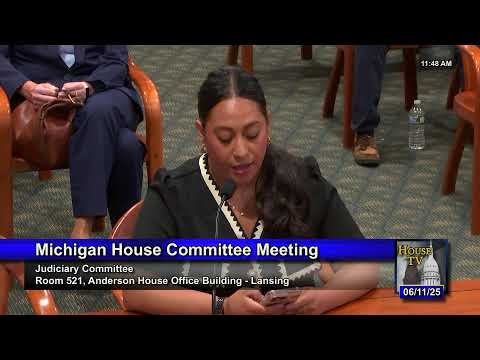
Representative Hope and other members raised constitutional questions and policy concerns on the record. Maya Menlo of the State Appellate Defender Office (SADO) and the Criminal Defense Attorneys of Michigan argued the bills raise constitutional problems, citing United States Supreme Court precedents (Roper, Miller, Montgomery) and Michigan Supreme Court opinions (Czarnecki and Taylor). Menlo said the constitution requires individualized sentencing that considers youth and that a statutory floor of 35–50 years could amount to a de facto life sentence for many younger offenders. She also warned of equal‑protection, separation‑of‑powers and ex post facto concerns that could invite prolonged litigation and delay resentencings.
Several victims and victims’ advocates testified in support of the bills. Roberta Gartley described the murder of her son and argued that age should not shield violent offenders from the most severe penalties. Prosecutors and victims' advocates stressed the need to recognize multiple victims when multiple homicides occur and to avoid concurrent sentencing that they said can undercount harm to victims.
Joshua Puckett, who identified himself as a formerly incarcerated person and the director of Adolescent Redemptive and Restorative Programs, opposed the bills and urged preserving judicial discretion for individualized review and rehabilitation, saying in part, "This bill would take away those judges' discretion to utilize their power." He described his own long incarceration and post‑release rehabilitation as evidence that some people convicted as young adults can be rehabilitated.
Committee members also heard from a range of organizations listed on the public record: ACLU of Michigan, Michigan Collaborative to End Mass Incarceration, Citizens for Prison Reform, Safe & Just Michigan, Life After '27, Michigan League for Public Policy and others opposing the bills or urging caution.
Representative Leitner said the committee will continue discussion and expects further work; no formal committee vote on the resentencing bills was recorded in the transcript excerpt.