Get Full Government Meeting Transcripts, Videos, & Alerts Forever!
Get email alerts on the Zoning Incentive Benefits topic
No spam. Unsubscribe anytime.
County executive and planning board back update to incentive-zoning public benefits point system
Summary
At a council public hearing, county and planning officials urged support for Zoning Text Amendment 25-05, which would replace the existing public-benefits point system for optional-method development with a tiered system; both called for clarifications to strengthen housing and alignment with master plans.
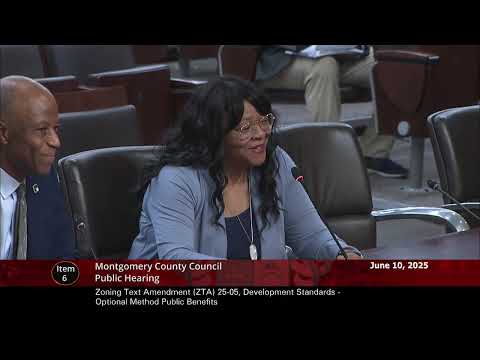
Montgomery County Council held a public hearing on Zoning Text Amendment 25-05, the development-standards proposal to update the public-benefits point system used in optional-method development in commercial, residential and employment zones. Ken Hartman Espada testified on behalf of the County Executive in support of ZTA 25-05, and Artie Harris, chair of the Montgomery County Planning Board, delivered the board's recommendation to support the ZTA with amendments.
The update, framed by the Planning Department's incentive-zoning analysis, replaces the long-standing point menu with a tiered approach. "Additional density," Hartman Espada said, "in the county executive's opinion should always come with real benefits to the public." He urged the council to consider further changes arising from Department of Housing and Community Affairs (DHCA) reviews to better realize workforce housing needs, including moderately priced dwelling units (MPDUs).
The planning board said the county has not comprehensively updated the point system since 2010. "Under the existing point system," Harris said, quoting the Planning Department report, "despite the vast menu, optional method projects have repeatedly delivered a handful of public benefits regardless of the underlying zone or market conditions." The board recommended the tiered system as a step toward ensuring optional-method projects move policy goals for economic competitiveness, environmental resilience and equity. Harris also transmitted language suggesting the ZTA explicitly allow overlay zones and master plans to prioritize or modify public benefits to align with local goals.
Planning staff and the county executive submitted written comments that the council may review, and department representatives indicated they will participate in upcoming work sessions. The Planning, Housing, and Parks Committee work session on this ZTA was noted as scheduled for 06/16/2025. No formal council vote on the ZTA occurred at the hearing; the item remained in the public-comment and work-session phase.
Supporters emphasized the ZTA is intended to produce more consistent and locally relevant public benefits from additional density, while speakers asked the council to add clarity on how the policy would deliver workforce housing and to allow master-plan‑level adjustments. Council members and staff are scheduled to consider those details in future committee meetings.