Get Full Government Meeting Transcripts, Videos, & Alerts Forever!
Get email alerts on the Community Colleges topic
No spam. Unsubscribe anytime.
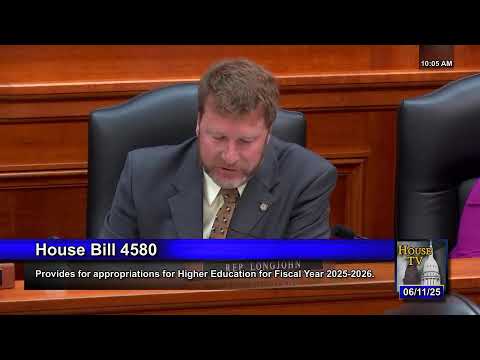
Subcommittee adopts community college H‑1 with tuition restraints, DEI and personnel limits
Summary
The House subcommittee adopted the H‑1 substitute for HB 4,579, a community college appropriation bill that reduces one‑time operations funding, adds tuition‑restraint reporting, and inserts boilerplate restricting DEI spending, salary allocations and athletic participation rules.
The House Appropriations Subcommittee on Higher Education and Community Colleges voted to adopt the H‑1 substitute for House Bill 4,579, the community college appropriation bill, moving the substitute out of committee on a recorded roll call.
House Fiscal Agency analyst Perry Zylak told the subcommittee the H‑1 substitute carries a gross appropriation of $456,700,000, entirely from the School Aid Fund (SAF), and represents a $5,600,000, or 1.2%, reduction from the current fiscal year, driven largely by removal of one‑time appropriations. "This includes a net decrease of $3,600,000 SAF for community college operations, a 1% decrease when compared to the current fiscal year," Zylak said, adding projected funding decreases for individual community colleges would range from about 0.8% to 1.3%.
The House substitute deletes certain one‑time appropriations and removes some executive recommendations for added funding. Zylak highlighted multiple boilerplate changes the House adopted: deletion of preferences for veteran‑owned businesses in Michigan goods and services language; new uniform reporting requirements tied to tuition and fee restraints; a restriction on community colleges spending any funding on DEI with amounts spent on DEI reduced from operations allocations; a cap that limits non‑instructional salary spending so that no more than 10% of salary spending goes to staff who do not teach, maintain facilities, or perform law‑enforcement functions, with excess amounts deducted from operations allocations; and language that bars biologically defined males from participating in biologically defined female intercollegiate sports teams, authorizing the state budget director to withhold 5% of monthly operations payments until an institution complies.
Zylak said the House also removed language that set the "60 by 30" goal — a target that 60% of Michigan residents obtain a postsecondary credential by 2030. Questions from committee members focused on the potential downstream effects of operation funding reductions. Representative Longjohn asked how colleges would avoid passing costs to students without additional operational support; Representative Rogers said she was "frankly surprised" by the decrease and voiced concern over removing veteran supports that had been favored in prior budgets.
The committee recorded a roll‑call vote on the motion to adopt the H‑1 substitute and then reported the substitute with a recommendation that it pass. Representative Longjohn and Representative Rogers voted no on the reporting motion; the substitute was adopted and reported by the committee.
The community college H‑1 substitute will proceed to the next legislative steps, where House, Senate and gubernatorial negotiators are expected to reconcile funding and policy differences.