Get Full Government Meeting Transcripts, Videos, & Alerts Forever!
Get email alerts on the State Budget topic
No spam. Unsubscribe anytime.
House panel adopts H‑1 substitute for HB 4,578 with cuts to staffing and new boilerplate restrictions
Summary
The Michigan House Appropriations subcommittee adopted the H‑1 substitute for House Bill 4,578, approving a budget that reduces overall FTE authorizations and adds multiple new boilerplate requirements for the Department of Labor and Economic Development (MyLEAD).
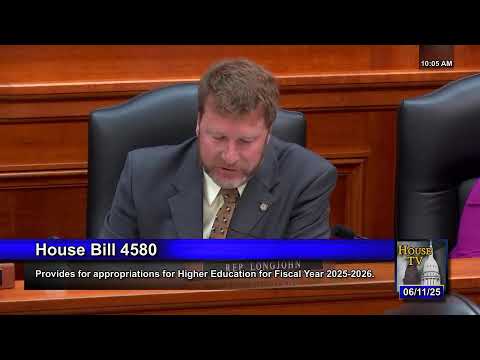
Chair Markkanen presided as the House Appropriations Subcommittee on Higher Education and Community Colleges adopted the H‑1 substitute for House Bill 4,578 on a voice roll call, moving the bill out of committee by recorded votes that resulted in the substitute being adopted and later reported with a recommendation to pass.
The substitute changes top-line funding and program authorizations for MyLEAD, House Fiscal Agency analyst Noelle Benson said. "There is a $3,500,000 overall gross decrease in the proposal versus year‑to‑date numbers for a total of $640,500,000 in the budget," Benson said, adding the proposal shows a 0.5% decrease overall, a $46,400,000 general‑fund increase and a $49,900,000 federal decrease. The proposal also reduces authorized positions from 343 to 281, a decline of 62 FTEs, or 18.1%.
The change includes a $44,300,000 increase for child development and care caseload costs, offset by a large federal shortfall that requires general‑fund support, Benson said. Other notable line‑item adjustments include reductions in information technology, childcare licensing and regulation, executive direction and student financial assistance. Benson said student financial assistance authorizations are cut by 15 FTEs and funding is reduced by $3,100,000 in general fund.
Perry Zylak of the House Fiscal Agency summarized new and revised boilerplate language the House added. Among the items Zylak highlighted: reporting requirements for severance pay for high‑ranking officials (14 days after agreements are reached); a prioritization of in‑person work for five days per week for MyLEAD employees, with field staff required to report into the office; quarterly grant transparency reports; a requirement that contractors and subcontractors use the federal E‑Verify system; and a restriction on use of DEI (diversity, equity and inclusion) funding within the department. Zylak also said the House added a provision that would subject the department to a $100 fine per violation if department employees use pronouns on email signatures, business cards or departmental letterhead and that this fine could be pursued by residents in the Michigan Court of Claims.
Subcommittee members asked questions and noted areas for negotiation with the Senate and governor. Representative Rogers asked why the proposal does not include funding to comply with recent federal changes to the child development and care program; Chair Markkanen said negotiation remains with the Senate and governor. Representative Longjohn expressed concern the subcommittee saw discrepancies between House Fiscal Agency summary numbers and the bill text only upon arriving in the room and said that complicates informed voting.
Formal actions recorded in the hearing included motions to adopt the H‑1 substitute and to report the substitute with a recommendation that it pass; the clerk called the roll on each motion and the chair announced the adopted results. The substitute was adopted in committee and later reported out with recorded votes noted in the hearing transcript.
The bill now moves to the next steps of the legislative process, where negotiators from the House, Senate and the governor's office are expected to reconcile differences before final appropriation decisions are made.