Get Full Government Meeting Transcripts, Videos, & Alerts Forever!
Get email alerts on the Telemedicine Optometry topic
No spam. Unsubscribe anytime.
Committee hears competing views on bill to allow online prescription renewals for contacts and glasses
Summary
Supporters told the House Health Policy Committee that online renewals will expand access and lower costs; optometrists and eye-care groups warned that current draft language lacks verification and could permit unsafe changes to contact lens prescriptions.
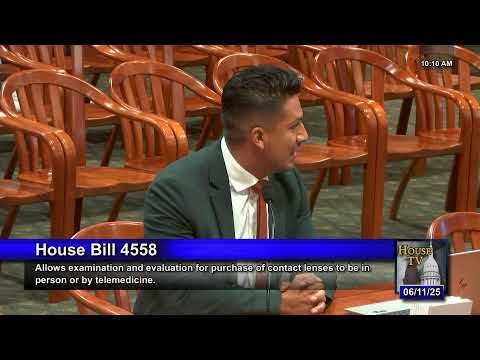
The House Health Policy Committee heard extensive pro and con testimony Tuesday on House Bill 45 58, a measure to allow online vision screenings and telemedicine renewals of existing eyeglass and contact lens prescriptions if the patient had an in-person visit within the previous two years.
Representative VanderWaal, the bill sponsor, said the legislation would let patients ‘‘renew their prescription, provided that they have received a valid prescription from an in person visit within the last 2 years’’ and that online renewals ‘‘maintain patient safety’’ while increasing convenience and lowering cost.
Supporters included David Gunther of the Mackinac Center, who said the law would expand consumer choice and reach patients in communities that lack local eye care; Jack Baum of Americans for Tax Reform, who described competition and choice benefits; and representatives of marketplace providers including a senior manager for 1-800 Contacts’ Express Exam service, who described automated health questionnaires, photos and remote acuity tests that feed a licensed physician’s review.
Eric Castaneda of 1-800 Contacts told the committee that ‘‘about 30 percent of patients who try for this type of system actually get screened out’’ and that a physician in the state reviews each renewal request and can refer patients for in-person care.
Opponents, led by physicians from the Michigan Optometric Association and Eye Care Partners, urged changes before passage. They said the bill’s draft changes the statutory definition of a ‘‘valid prescription’’ in a way that could permit online renewals to alter contact-lens parameters other than refractive power — including base curve, diameter and lens brand — and that such changes could harm patients because contact lenses are medical devices that must fit the cornea and allow oxygen exchange.
Doctor Whitney Genrich, vice president of the Michigan Optometric Association, told the committee the draft ‘‘creates 2 separate types of prescriptions’’ and recommended requiring online providers to obtain the patient’s existing prescription from the in-person provider rather than relying on patient-entered data.
Witnesses for eye-care providers cited the federal Fairness to Contact Lens Consumers Act and the FTC contact-lens rule, which require prescription verification for lens sellers, and asked that renewal software likewise be required to verify the previous prescription parameters rather than allowing a simple patient statement that an exam occurred within two years.
Representatives on the committee pressed witnesses about data on harms and the practical effect of verification requirements. The optometrists said large-scale, long-term outcome studies are scarce because the transition to online services is relatively recent and reporting is often ad hoc, though they said their associations and federal reporting mechanisms (FTC, FDA MedWatch) collect adverse reports.
Proponents argued that many other states allow online renewals, that the FDA has cleared some examination technologies, and that patient protections in HB 45 58 — including a required in-person exam at least every two years and physician review of online screenings — are sufficient. Opponents countered that the bill’s present language lacks guardrails to guarantee that an online renewal cannot change fit-related parameters without an in-person fitting.
No committee vote on HB 45 58 was recorded in the hearing transcript; committee members said they would continue to work with stakeholders on language changes and asked witnesses to provide draft statutory language and technical fixes.