Get Full Government Meeting Transcripts, Videos, & Alerts Forever!
Get email alerts on the Substance Use Disorder topic
No spam. Unsubscribe anytime.
Seattle expands mobile and community-based opioid treatment and overdose-prevention services in 2025 investment plan
Summary
The Seattle Human Services Department and Public Health—Seattle & King County outlined a package of 2025 investments on June 11 intended to expand access to medication for opioid use disorder and community-based overdose prevention across the city.
The Seattle Human Services Department and Public Health—Seattle & King County outlined a package of 2025 investments on June 11 intended to expand access to medication for opioid use disorder and community-based overdose prevention across the city.
"The new investments will also guarantee that more than 5,000 Seattle residents will be served with, overdose prevention and medicine for opioid use disorder annually with more than a thousand new patients engaged in treatment," said Anne Gorman, senior policy adviser, Human Services Department, during the committee briefing.
The council committee heard that the 2025 public-health contract reallocates existing city funding to prioritize opioid and behavioral-health needs directed by Mayor Bruce Harrell. HSD told the committee that the line items dedicated to substance-use-disorder (SUD) access and treatment increased by more than 200% inside the public-health contract, and that adding in other HSD investments raises the total increase to more than 300% compared with 2024.
Public Health staff described a set of new and expanded programs intended to reach people who are unhoused or otherwise hard to engage in clinic settings. David Sapienza, an addiction medicine physician with Public Health—Seattle & King County, said the plan includes a new high-intensity street outreach team that will provide same-day access to long-acting injectable buprenorphine in the field. "The team will consist of a nurse who will administer the injections and a community health worker," Sapienza said. He described minimum impact targets for the pilot: at least 75 new patients started on buprenorphine in the field, at least 150 injections administered, and 25 patients receiving oral buprenorphine prescriptions for delivery when clinically appropriate.
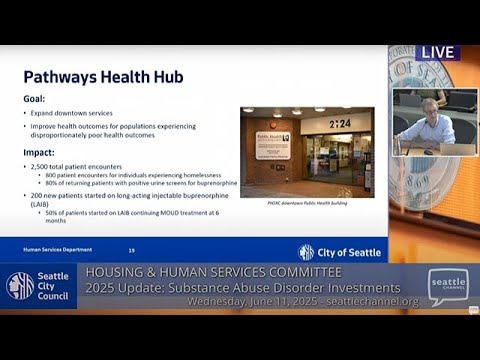
Public Health also described a significant expansion of the downtown Pathways clinic. Sapienza said the expanded Pathways hub will add medical and wraparound services to improve retention in care: "Initial minimum impact measures are at least 2,500 total patient encounters, at least 800 of those for individuals experiencing homelessness... at least 200 new patients will be started on long-acting injectable buprenorphine with at least 50 remaining on the medication at the 6 month follow-up visit." The department said providing co‑located services such as wound care, STI testing, vaccinations and other basic medical care should increase retention.
Evergreen Treatment Services will purchase a clinical intake vehicle to accompany its mobile methadone units, Public Health said. That van will allow clinicians to perform the clinical intake visit at the site, reducing the travel and time barriers that have hindered some patients from starting methadone. Evergreen estimated the vehicle would support roughly 1,500 supportive-service contacts, engage 500 clients, and bring about 250 new patients into treatment through that intake capacity.
Public-health staff described a community‑based overdose prevention program funded through a competitive RFP. Seven applicants responded; five programs met eligibility and received full or partial awards to expand outreach across North and South Seattle. Public Health said awardees will distribute an estimated minimum of 40,000 doses of naloxone, serve a minimum of 5,000 clients, and provide at least 5,000 referrals to MOUD (medication for opioid use disorder).
Brad Finegood, a Public Health staff member who responded to a question about federal funding, warned of uncertainty: "We are deeply concerned about the proposed Medicaid cuts and especially work requirements because we know that so many folks are are out there struggling." He and colleagues said cuts to federal support—SAMHSA and CDC grants and possible block-grant reductions—could affect surveillance, drug-checking and linkage-to-care work.
Committee members asked about evaluation and reporting. Public Health said the community-based awardees will report quarterly to the county on the output metrics listed above and provide narrative reports describing service delivery, client characteristics (when available) and challenges. Public Health said it will combine these program reports with surveillance data from CDC-funded work to monitor broader trends in linkage to care and service uptake across King County.
Councilmembers pressed for more detail about contracting and partners. Staff said two embedded care-navigation positions will be funded to support UW Telebup and the ORCA center, and that Catholic Community Services, DESC and the Urban League are among named partners for specific program elements. Staff offered to provide a written crosswalk mapping contract line items to the field programs and to return to council with implementation updates.
Public comment touched on the briefing's subject. Holly Willis, policy manager at the Coalition on Homelessness, urged passage of tenant-protection legislation mentioned later on the agenda and said expanded treatment funding is important to keeping people housed. Andrea Suarez, a public commenter, criticized some harm‑reduction providers for distributing paraphernalia she described as dangerous; Suarez framed those complaints as a call for the city to reconsider some community funding decisions. The committee heard both support for expanded treatment access and concerns about the role of harm-reduction programming.
The Human Services Department and Public Health described the package as a set of complementary strategies—outreach, care navigation, mobile medication access and clinic expansion—designed so people can enter treatment at multiple points. The items discussed were presented as a briefing; the committee did not take a legislative vote on the public-health contract during this meeting.
Implementation and oversight: Public Health said hiring for the mobile buprenorphine team was underway and that onboarding the nurse would determine how quickly street outreach could begin. Staff also noted the work is happening amid federal funding uncertainty and said the city will monitor data and return with updates.
What to watch next: HSD and Public Health committed to quarterly program reporting and to returning to the committee with progress updates on the mobile-treatment pilots and Pathways expansion.