Get Full Government Meeting Transcripts, Videos, & Alerts Forever!
Get email alerts on the Golf Management topic
No spam. Unsubscribe anytime.
Parks previews new golf management agreement; vote delayed for further briefings
Summary
Seattle Parks and Recreation briefed the Parks, Public Utilities and Technology Committee on June 11 on a proposed golf-course management agreement (Council Bill 120999) that would continue private management of four municipal courses and require formal public-benefit reporting; committee members delayed a final vote for additional briefings.
Seattle Parks and Recreation and its current operator briefed the Parks, Public Utilities and Technology Committee on June 11 about a proposed golf-course management agreement under Council Bill 120999 and the department's expectations for public benefits, capital investment and reporting.
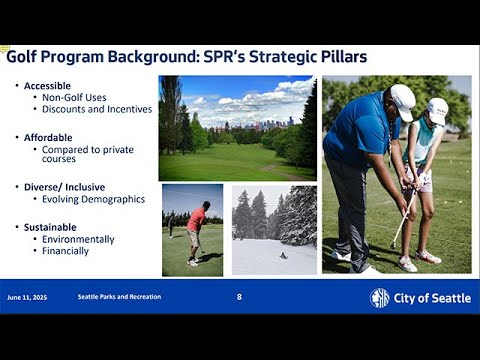
Parks Superintendent AP Diaz and golf manager Patrick Merriman outlined the department's goals for accessibility, affordability, environmental stewardship and youth outreach. Premier Golf Centers — the city's incumbent operator — and representatives from Troon described recent pilots and community programs, and Premier's director of operations, Michael Fosnick, said the company will formalize annual public-benefit targets and provide an annual public-benefit report within 60 days after each fiscal year.
Key figures and commitments: Premier agreed to a capital commitment of $1,500,000 over the contract term (approximately $100,000 per year). Parks staff said the golf program covers about 500 acres across four municipal sites and uses 23 full-time city staff for course maintenance. Using 2024 as an example, Parks reported golf operating expenses of about $17 million, revenues of about $19 million, and transfers to golf capital projects of roughly $2 million; transfers since 2020 have ranged between $1.3 million and $2.0 million per year.
Parks described the relationship as an operating agreement (not a lease) in which Premier manages day-to-day operations (tee times, pro shops, restaurants and programs) and the city retains maintenance responsibilities. The draft agreement updates payment-card industry compliance requirements, requires annual target metrics for public benefits, and formalizes reporting and transparency obligations so future priorities can be adjusted with the operator.
Premier highlighted youth outreach pilots and one-day community events. Fosnick said a recent citywide "Seattle swing" event delivered free lessons, Toptracer access and discounted green fees and that the one-day public-benefit value for the event was about $17,000. Premier and Parks described plans to expand successful partnerships — for example, Jefferson Park programming has grown from 7 to 35 youth participants year-over-year — and to explore expanded coordination with community centers near each course.
Committee reaction and next steps: Councilmembers praised the department's stewardship, raised questions about stronger integration with nearby community centers and asked that Parks and Premier work with council offices on any additions to the public-benefit package. Councilmember Strauss emphasized environmental and multiuse benefits at Interbay and other courses; Councilmember Kettle pressed for clearer community-center integration plans; and Councilmember Rivera and others stressed mental-health and youth-access benefits.
The committee did not vote on the ordinance on June 11; members said they wanted additional briefings and to refine public-benefit metrics before final action. Parks and the operator said they are willing to continue working with council offices on potential public-benefit adjustments before a future committee vote.