Get Full Government Meeting Transcripts, Videos, & Alerts Forever!
Get email alerts on the Telecommunications topic
No spam. Unsubscribe anytime.
Bonner County commissioners direct staff to draft code amendments tied to HB 180; public raises health and notice concerns
Summary
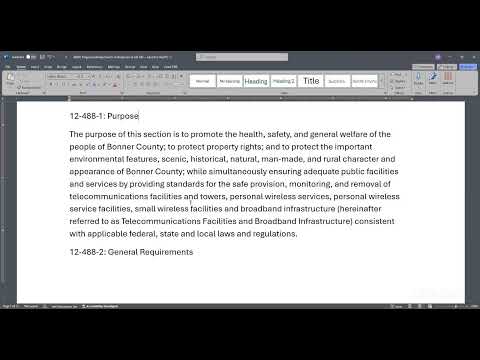
Bonner County commissioners voted June 10 to direct staff to draft amendments to the county land‑use code to address telecommunications facilities and broadband infrastructure ahead of House Bill 180’s July 1 effective date.
Bonner County commissioners voted June 10 to direct staff to draft amendments to the county land-use code to address telecommunications facilities and broadband infrastructure ahead of the July 1 effective date of House Bill 180.
County Attorney Bill Wilson opened the workshop by identifying the two statutory provisions central to the discussion and how they interact: “So the 2 codes are are 67Dash6540 and 61Dash538,” he said, and emphasized that the statutes appear to split responsibilities between local land-use review and regulation of pole-attachment disputes handled by the Public Utilities Commission (PUC). Wilson summarized his reading: “That the county reserves the right to regulate for land use, and the PUC, it's to regulate the relationship of the utilities.”
Commissioner Domke, who led the staff presentation, framed the board’s objectives before public comment: “we have, in my opinion, a constitutional obligation to protect the health, safety and welfare of the public,” and said the draft language aims to balance that obligation with the limits imposed by state and federal law.
Why it matters: HB 180 changes how Idaho defines and treats certain telecommunications and broadband facilities. The board’s action starts a code-amendment process that will go to the Planning Commission and legal review before returning to the board. Drafting new local rules now will give Bonner County staff and elected officials a chance to define application requirements, notice distances, setback rules and decommissioning bonds before any substantial local deployments occur.
What the draft will cover and what the board flagged for further work - New definitions and a unified term: the draft uses “Telecommunications Facilities and Broadband Infrastructure” to capture both federal and state categories (personal wireless services, small wireless facilities, pole attachments and traditional towers) and to reduce loopholes that could allow different facilities to evade county review. - Application completeness: the draft would require applicants to include reasoned statements and supporting evidence for every item claimed in the application. The planning director could deem an application incomplete and hold the statutory shot clock until materials are complete. - Noticing and community input: the draft recommends mailing notice to property owners within 1,500 feet of a proposed site for tower-style facilities (larger than typical 300-foot notice) and added that planning staff should craft a clear, enforceable public-notice procedure. - Alternative-site analysis and drive-test data: applicants would need to document good-faith attempts to co-locate on existing facilities and provide raw drive-test data in a standardized format (not just summary slides) so staff and reviewers can evaluate claimed network gaps. - Setbacks and siting limits: the draft proposes limiting where new towers may be sited by relying on zoning designations (for example, allowing towers only in larger-acreage zones such as Ag-Forest 20 or Forestry 40, and not in smaller residential zones) and placing a minimum offset from existing dwellings (the draft used 1,000 feet as a starting point under discussion). - Safety, design and decommissioning: the draft would require an FCC-compliance report prepared by a licensed engineer, bonding to cover decommissioning and restoration, and a mechanism to revoke conditional-use permits if facilities are abandoned or become a public nuisance.
Public comment and technical concerns Residents and callers voiced a mix of technical, health and land-use concerns and recommendations: Ann Wilder, a West Bonner County resident who submitted draft language and cited other municipal ordinances, urged specific application items such as drop-call records, independent engineering review and per-site conditional-use permits rather than batched permits. “I went through the Bonner County code and looked at areas that I saw specifically lacking and, tried to write in where I believe that the changes should be made,” Wilder said.
Other residents urged stronger health protections and larger buffers. Joan (last name not given) recommended hiring a technical expert to craft the ordinance and said, “This ordinance needs to be crafted by a combat general.” Danielle Kins (Kims), who identified a military electronic‑warfare background, urged the board to consider measurement thresholds and EMF monitoring protocols: “I would encourage you to look into the threshold that the FCC sets for, setting warning labels on any devices.” Several speakers asked the board to require applicants to provide the underlying measurement data used to claim a coverage gap.
Board direction and next steps After discussion, the board voted to direct staff to prepare a full draft code amendment for review by the Planning Commission and by legal counsel. The motion as recorded directs the planning department to prepare a formal draft that will be circulated for public hearings and further revisions; staff and commissioners specifically noted the draft is an initial, working starting point and that additional public comment and legal review will follow.
The board said the Planning Commission process and further legal review (in‑house or outside counsel) will provide multiple additional opportunities for public input before any final adoption. Several commissioners and members of the public recommended the county consider outside technical and legal expertise during the drafting and review phase.
What the county did not decide The board did not adopt final numeric distances, bonding amounts, or definitive tables tying frequency/power to setback distances. Commissioners and staff repeatedly characterized these items as draft placeholders that require further technical and legal review. No formal policy on EMF thresholds or mandatory environmental/health testing was adopted at this meeting.
What to expect next Planning staff will compile the proposed language into a full draft amendment, circulate it to the Planning Commission and county legal staff for review, and schedule public hearings as required under county code. Commissioners said they expect further public input and potential revisions after the Planning Commission’s recommendation and any outside legal or technical review the county chooses to secure.
Ending: The board concluded the workshop by voting to proceed with drafting the formal code amendment; commissioners emphasized that the process will include additional public hearings and legal review before any ordinance change is finalized.