Get Full Government Meeting Transcripts, Videos, & Alerts Forever!
Get email alerts on the Referrals Packages topic
No spam. Unsubscribe anytime.
Evanston referrals committee sends housing, procurement, ethics and licensing items to standing committees
Summary
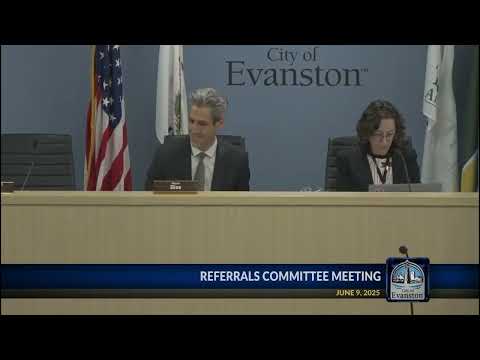
At its June 9 meeting the Evanston Referrals Committee voted to send a package of policy items — including inclusionary housing affordability terms, a procurement code overhaul, vacation-rental licensing and rules on ethics determinations — to the relevant standing committees with recommended timelines.
The Evanston Referrals Committee on June 9 voted to refer a set of policy items to standing committees, setting tentative timelines for committee review and asking staff to return with details.
Committee members front‑loaded a discussion of the inclusionary housing ordinance’s affordability term, then moved through items including mandatory auditor rotation, a procurement code overhaul, a rules cleanup, a code clarification on plan‑development thresholds, automatic release of ethics board determinations, a reevaluation of the vacation‑rental licensing process, and review of sweepstakes machines that city staff described as operating in a legal gray area.
The inclusionary housing item concerns how long mandated affordable units must remain affordable. Committee members said the current interpretation treats extremely rare ownership units as affordable in perpetuity and rental units as subject to a 30‑year affordability term. The committee referred that item to the Housing & Community Development Committee (HCDC) with a recommendation that it be heard in the third quarter or earlier.
A proposal to require mandatory rotation of the city’s auditors was characterized by members as a policy question rather than an ordinance. The committee referred the auditor‑rotation discussion to the Finance & Budget Committee with a recommendation that it be scheduled by September.
The committee also referred a broad overhaul of the city’s procurement code to the Administration & Public Works Committee (APW). Members and staff described the effort as complex and long‑running; they set a target of January 2026 for APW consideration while acknowledging the work could extend into 2026.
A rules cleanup item was placed on the Rules Committee’s next agenda. A separate request to automatically release special ethics council determinations — including instances where complaints were not pursued — was likewise referred to the Rules Committee, with staff saying the code change would be relatively straightforward to present.
On planning and zoning matters, the committee referred a clarification of mandatory plan‑development thresholds to the Land Use Commission for its July 9 meeting. Staff described the item as a clarification of interpretation concerning whether bonus units should be counted toward threshold totals, not as a correction of the code text itself.
The committee discussed sequencing between the strategic housing plan and zoning code updates but did not make a referral; members said they wanted alignment and transparent public engagement on that sequencing before moving forward.
Regarding vacation rentals, staff told the committee the city is still identifying roughly 200 currently functioning units and does not yet know what share are owner‑occupied. The committee referred the reevaluation of the vacation‑rental licensing process to HCDC with a recommendation to hear it by October, and staff said the item could be folded into the strategic housing plan timeline.
Finally, the committee referred a review of sweepstakes machines — described by staff as appearing to operate in a legal gray area — to the Human Services Committee with a recommendation for third‑quarter consideration.
All of the motions on the record were approved unanimously by those present (three in favor, none opposed), and the committee adjourned to allow the city council meeting to begin when a chamber quorum was available.