Get Full Government Meeting Transcripts, Videos, & Alerts Forever!
Get email alerts on the Salmon Recovery topic
No spam. Unsubscribe anytime.
King County staff seek renewals of watershed interlocal agreements; Howard Hanson funding remains uncertain
Summary
County staff briefed the committee on renewing three 10‑year interlocal agreements that coordinate salmon recovery across King County watersheds, highlighted accomplishments and flagged an unfilled funding gap for Howard Hanson Dam fish‑pass work after recent federal budget actions.
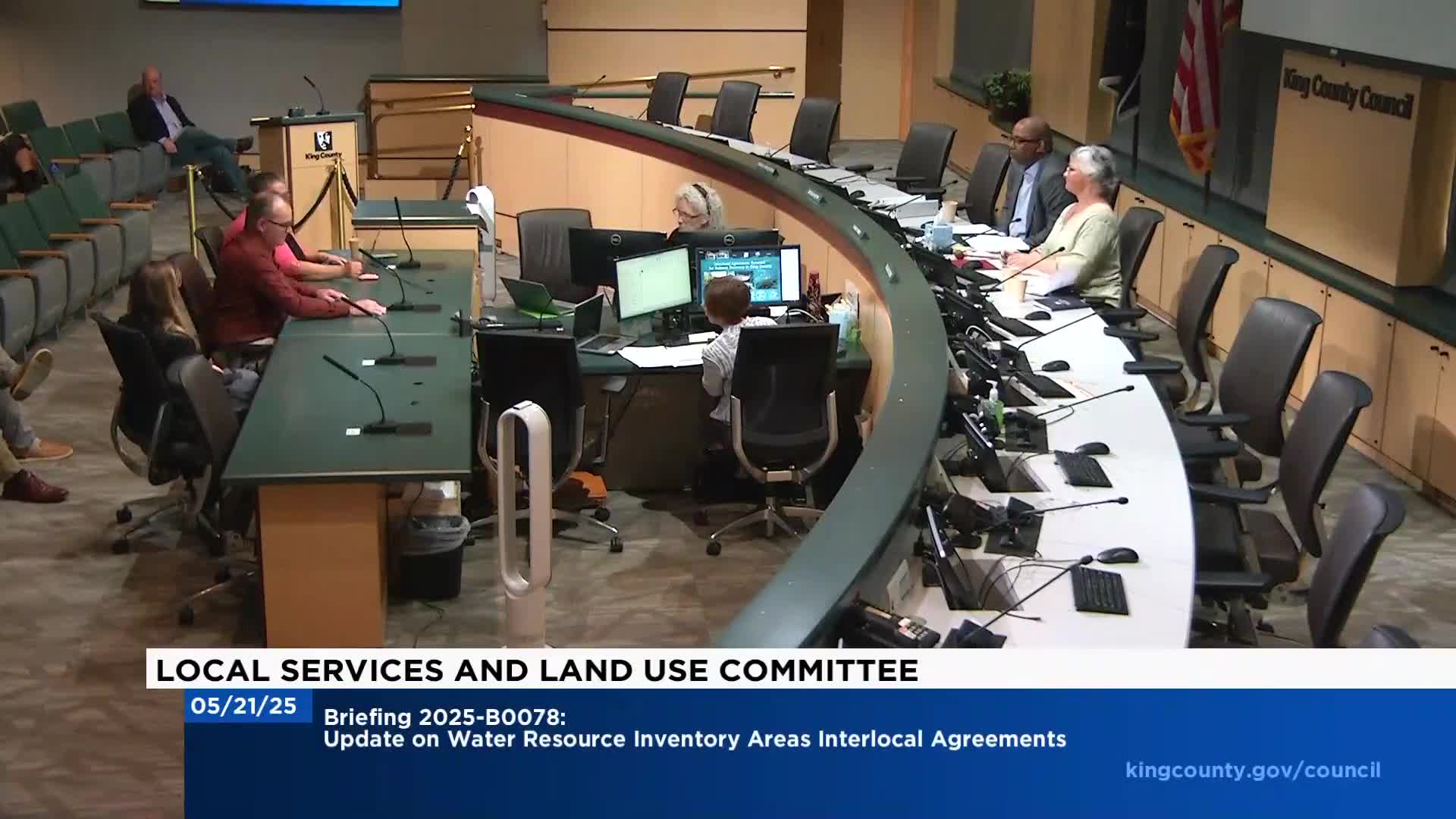
King County Water and Land Resources Division staff on May 21 briefed the Local Services and Land Use Committee on the renewal of three interlocal agreements (ILAs) that coordinate watershed‑scale salmon recovery in King County’s principal watersheds.
The ILAs cover watershed partnerships commonly called RIAs (Water Resource Inventory Areas) 7 (north), 8 (Lake Washington–Cedar–Sammamish), and 9 (Green/Duwamish). The current agreements have supported coordinated planning and project delivery for about 25 years; staff said the agreements are being updated for another 10‑year term and must be signed by member governments before the end of the calendar year.
Why it matters: The ILAs are the governance framework for shared salmon recovery work — from floodplain reconnection and fish passage projects to riparian planting and outreach — and they help coordinate investments across cities, tribes and the county. Renewing the agreements preserves that collaborative structure and clarifies King County’s role as fiscal agent and service provider.
Jan Nik Ayem, supervisor of the regional partnerships unit in King County’s Water and Land Resources Division, said King County serves as the fiscal agent and service provider for the three ILAs and highlighted coordinated accomplishments such as large floodplain reconnection projects and numerous tributary and fish‑passage restorations. Staff described each ILA’s scale: RIA 7 is geographically large with eight members including two tribes; RIA 8 counts about 28 member jurisdictions and includes densely populated cities such as Seattle and Bellevue; RIA 9 includes King County and 16 cities and has a persistent focus on large fish‑passage projects such as Howard Hanson Dam.
Status and schedule: As of the May 21 briefing, staff reported about half of the member governments had signed the updated agreements and additional signatures were forthcoming; the county expects to transmit finalized agreements to council on or about July 1 and seeks full execution before year end.
Howard Hanson Dam: Matt Goring, salmon recovery manager for RIA 9, briefed the committee on a major federal funding uncertainty for Howard Hanson Dam fish‑pass construction. He said the president’s budget had proposed roughly $500 million to support Army Corps construction work for downstream fish passage, but the recent federal continuing resolution provided a lump construction sum without project earmarks and the Army Corps’ subsequent national work plan did not include Howard Hanson. Goring said a design‑build contract with a construction option exists, but agencies lack clarity on whether the Corps will hold available funds for the project or how long the construction option can be exercised without restarting procurement. Staff described ongoing outreach to Washington’s congressional delegation and federal partners to secure funding.
Committee members asked about next steps and whether the updated ILAs introduce substantive changes. Ayem and colleagues said the agreements themselves are minorly edited to ensure consistency across RIAs and to reflect administrative updates; the more material changes to salmon recovery work will be driven by new challenges such as climate impacts, stormwater effects and new state funding for riparian planting.
No formal committee action was taken; the briefing was for discussion and informational purposes only.