Get Full Government Meeting Transcripts, Videos, & Alerts Forever!
Get email alerts on the State Legislation Review topic
No spam. Unsubscribe anytime.
King County reviews 2025 Washington legislative session: housing, transportation and behavioral-health wins and gaps
Summary
Mac Nicholson, director of government relations, gave the Committee of the Whole an overview of the 105‑day 2025 session, noting budget shortfalls, a package of new state revenues, transportation funding changes, partial behavioral‑health investments and mixed results on King County legislative priorities.
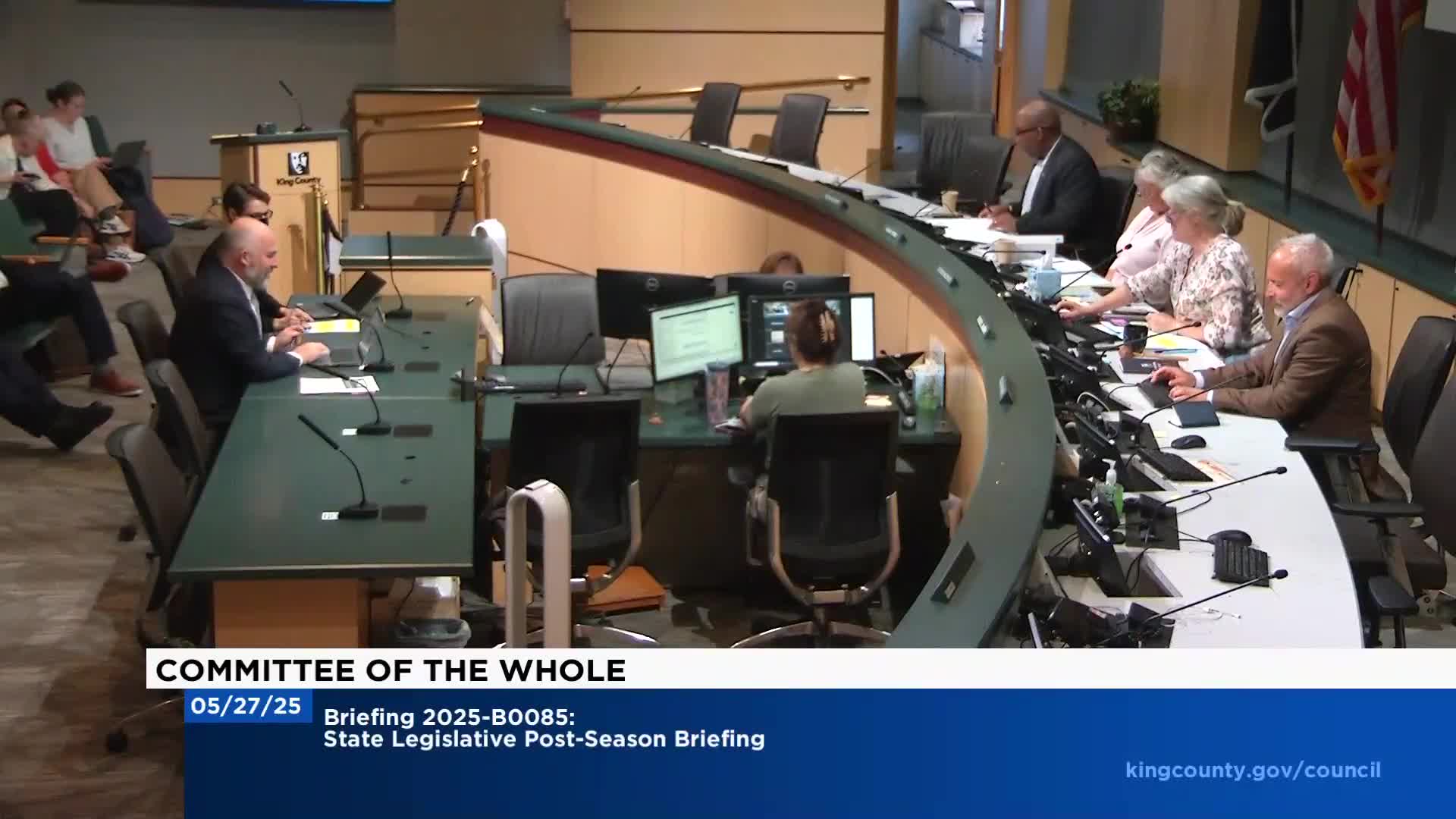
Mac Nicholson, King County’s director of government relations, briefed the Metropolitan King County Council Committee of the Whole on the 2025 Washington legislative session during the May 27 meeting, summarizing enacted budgets, major bills and how the session affected King County priorities.
Nicholson said the session ran 105 days, produced roughly 1,900 introduced bills with 423 enacted, and that the state adopted operating, transportation and capital budgets after an initial revenue shortfall estimate grew from roughly $10–12 billion to $15–16 billion in the forecast. He highlighted a state revenue package that raises approximately $4 billion in the next biennium through measures including changes to business-and-occupation taxes and expansion of the sales-tax base via a tobacco-products and other retail expansion (ESSB 5814), and noted a transportation revenue package that includes a 6¢ gas-tax increase and other vehicle taxes.
Why it matters: Nicholson ran through items that relate directly to county operations — public defense, public health foundational services, behavioral-health capacity grants, housing trust fund investments, and local road preservation funding. He flagged a $24 million reduction in statewide foundational public-health services, $130 million in behavioral-health community capacity grants (including competitive funds), and $605 million in total housing trust fund investments in the capital budget (with a mix of competitive and formula funds).
Notable outcomes related to county priorities
- Public defense: The state provided a $27.2 million statewide grant for public defense, with King County expecting a portion of the formula grant (historically ~21.5%). - Behavioral health: The legislature funded crisis‑relief centers and a $130 million set of behavioral-health community capacity grants, and passed HB 1813 requiring a Medicaid rate study adjustment mechanism. - Housing and homelessness: Capital funding included $605 million to the housing trust fund and $117 million addressing document‑recording fee shortfalls. - Transportation: The transportation budget included a 6¢ gas-tax increase, a permanent share of sales tax to transportation in 2028 (approx. $300 million annually), and a mix of local‑project investments including $9 million in multimodal funds for World Cup services (40% to King County Metro).
What didn’t pass
Nicholson said proposals that fell short included a county property-tax‑growth-cap lift (local 1% property-tax cap), a REET for county affordable housing increases, a short‑term lodging tax for workforce development, and several bills related to municipal solid‑waste renewable energy. He also said the bill to define and expand housing types in urban areas (SHB 1195 or related bills) did not pass in the form King County sought.
Ending
Balducci thanked Nicholson and staff and praised the government relations team’s coordination with council offices and the executive. Council members discussed continued advocacy strategies and whether the county should pursue more targeted, systemic lobbying on sustainable county funding going forward.