Get Full Government Meeting Transcripts, Videos, & Alerts Forever!
Get email alerts on the Litigation Against Federal Conditions topic
No spam. Unsubscribe anytime.
King County briefs council on lawsuits challenging federal conditions, DOJ bounty risk and agency reallocation
Summary
Executive General Counsel David Hackett described three lawsuits the county joined challenging Trump administration executive orders and grant conditions, highlighting legal theories (separation of powers, anti-commandeering, vagueness, APA claims) and a newly flagged DOJ memo that could encourage false-claims suits over DEI certifications.
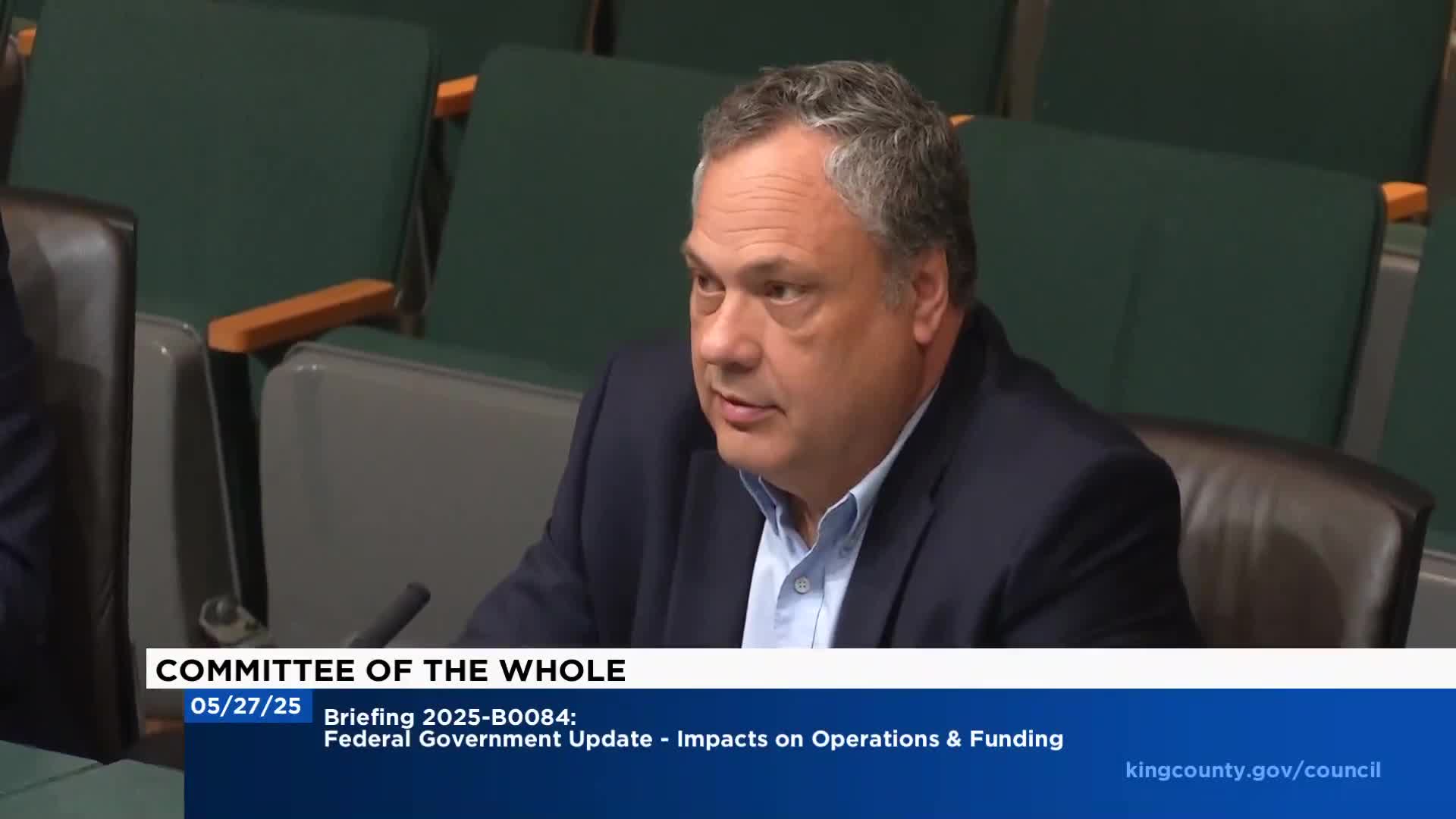
King County Executive General Counsel David Hackett briefed the Committee of the Whole on May 27 about ongoing litigation the county has joined against the Trump administration, describing the legal grounds, scope and potential risks to local governments.
Hackett said King County is party to three principal suits: the San Francisco v. Trump local-government challenge to immigration-related executive-action conditions; American Federation of Government Employees v. Trump, a challenge joined by unions and local governments to executive actions the plaintiff coalition says attempt to dismantle federal programs; and King County v. Turner, a suit challenging new conditions attached to HUD and other federal grants. Hackett said the last case included challenges to conditions that would require countywide certifications about diversity, equity and inclusion and described the certification provision as a potential "poison pill" that could expose jurisdictions to enormous liability under the False Claims Act.
Why it matters: Hackett told the committee the department and county joined the suits because the administration is attempting to impose new conditions or reallocate appropriated funds in ways that local governments see as inconsistent with congressional direction, and because the new conditions could expose counties to triple-damages liability or private bounty litigation.
Key legal points
Hackett described the county’s principal arguments as separation-of-powers and anti-impoundment claims (a president may not unilaterally refuse to spend funds Congress has appropriated), anti-commandeering (the administration cannot force local entities to enforce federal immigration law), vagueness and arbitrary-and-capricious Administrative Procedure Act claims regarding undefined terms such as "DEI" or "gender ideology," and due-process risks for local governments and contractors.
Hackett said King County joined early in March in a consolidated case out of San Francisco and had a preliminary injunction in place regarding certain immigration enforcement-to-funding conditions. He described an amended complaint in the HUD/FTA matter that included DOT/FAA interests and a preliminary injunction/temporary restraining order that preserved grant status while the courts consider the claims. "This becomes a poison pill that no one can swallow," Hackett said, summarizing the county’s concern about the false-claims exposure of a broad DEI certification.
DOJ memo and bounty risk
Hackett told the council that on May 19 the U.S. Department of Justice issued a memo directing its prosecutors to initiate False Claims Act cases in this space and encouraging private whistleblowers, which he said dramatically increases litigation risk for local governments.
Discussion and next steps
Council members asked whether King County could be a party to broader challenges if federal agencies reallocate appropriated funds. Hackett said that redirections by implementing agencies (for example, Corps of Engineers project lists) present constitutional and statutory questions but litigation typically involves the appropriated beneficiary; in many cases King County is not a direct beneficiary and would not be the plaintiff in those suits. He said the county will continue to monitor agency actions and coordinate with other jurisdictions.
Ending
Balducci thanked Hackett and noted the council will continue watching litigation outcomes as they inform contingency planning and grant administration.