Get Full Government Meeting Transcripts, Videos, & Alerts Forever!
Get email alerts on the Federal Budget And Operations topic
No spam. Unsubscribe anytime.
King County officials warn House budget resolution could cut Medicaid, SNAP and climate funding; urge contingency planning
Summary
County Chief Operating Officer Dwight Dively told the Metropolitan King County Council committee that the U.S. House budget resolution passed last week would, if implemented as written, reduce Medicaid, SNAP and clean-energy funding over a 10-year period and that King County is planning fund-by-fund contingencies for likely shortfalls.
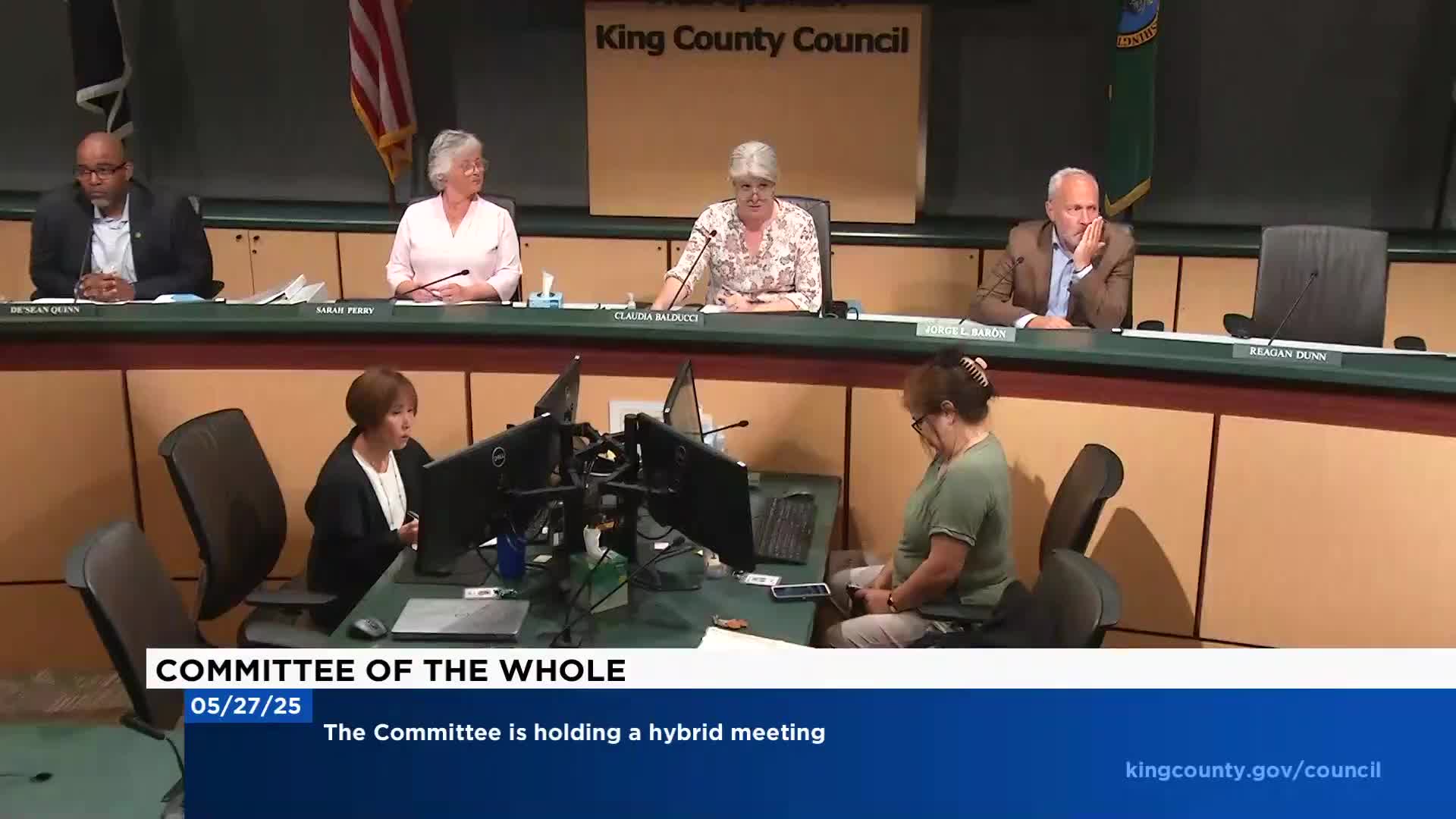
Chair Claudia Balducci convened a Committee of the Whole briefing on federal actions affecting King County operations and budget on May 27, 2025, where Dwight Dively, director of the Office of Performance, Strategy and Budget and chief operating officer for King County, outlined likely impacts if the House budget resolution were enacted as written.
Dively told the committee that the House resolution is a high-level 10-year spending framework and not the detailed appropriations bills that actually fund federal programs. He warned that "the largest set of budget reductions that are called for is roughly $800,000,000,000 of cuts to Medicaid," and that a proposed roughly $270,000,000,000 in cuts to the Supplemental Nutrition Assistance Program could reduce benefits or eligibility. He also noted "lots of reductions in clean energy funding" and said the Congressional Budget Office estimates the measure would add about $3,100,000,000,000 to federal debt over 10 years — or $5,100,000,000,000 under some extension scenarios — with market interest-rate consequences.
Why it matters: Local governments and counties like King County rely on federal funding for transit capital, public health programs, housing and other services. Dively said Medicaid cuts would likely increase demand on county public health clinics, reduce reimbursement rates and shift some costs to employer-sponsored or county-managed health plans. He described downstream effects on Metro transit bus purchases (largely federally funded), permitting revenue declines tied to higher interest rates, and the possibility of reduced grant support for county climate and zero-emissions programs.
Most important facts
Dively highlighted four items likely to affect county operations if implemented as outlined by the House resolution: Medicaid reductions (roughly $800 billion over 10 years), SNAP reductions (roughly $270 billion), cuts to clean-energy funding (a rough order-of-magnitude estimate around $100 billion based on the county briefing), and a large projected increase in federal debt that has already pushed market interest rates higher.
Dively described operational consequences and contingency approaches: Metro would have to reallocate local funding, potentially reduce service or delay bus purchases; the county’s permitting division had seen its worst nine months in its history as mortgage and financing costs rose; public health would face categorical grant shortfalls and might require general fund backfill that the county cannot fully absorb; and the executive is considering increased general-fund reserves to create flexible capacity in the 2026–27 biennial budget.
Discussion, questions and clarifications
Council members asked for more detail on municipal-bond tax deductibility and on approximate scales for clean-energy cuts and permitting revenue loss. Dively said the House resolution did not eliminate municipal-bond tax deductibility, though the subject remains under discussion, and estimated clean-energy cuts on the order of $100,000,000,000 while putting permitting revenue loss in the range of $1 million to $2 million per year for that division, representing 20–25% of that division’s budget.
Contingency planning
Dively emphasized contingency planning is being done fund by fund because many county revenue streams and grants are legally or contractually restricted. He recommended building additional flexible reserves in the executive’s 2026–27 budget proposal so the county can respond to federal cuts it cannot yet quantify.
Ending
Balducci said the council will continue the topic in a joint June 20 meeting with the Seattle City Council Special Committee to coordinate county and city contingency planning and assess impacts on the region’s economy and revenue base.