Get Full Government Meeting Transcripts, Videos, & Alerts Forever!
Get email alerts on the City Budget topic
No spam. Unsubscribe anytime.
Coral Gables officials warn tighter revenues will force tradeoffs as pension and one-time gains clash
Summary
Finance staff told the City Commission the FY26 capital budget relies more on one-time funds than in prior years, while recurring revenue available for capital has fallen; commissioners debated the $2 million annual pension COLA, a $3.6 million solid-waste fee cut and the risk of using interest income to pay ongoing costs.
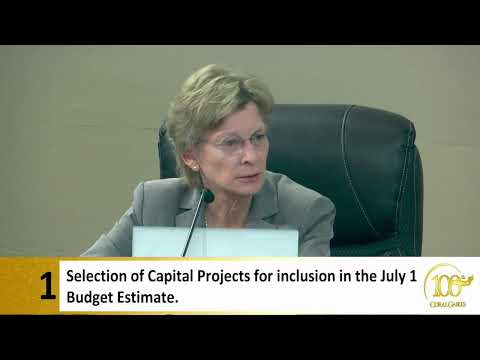
Coral Gables finance staff told the City Commission at a June capital workshop that the FY26 capital plan is being built on weaker recurring revenue than in recent years and on a larger share of one-time funds, leaving fewer resources for long-term priorities.
Assistant Finance Director Paula Rodriguez told commissioners, “Our June 1 property values came in with an increase of about 5.4% … that generates an additional approximately $7,000,000 based on the current millage of 5.559.” She also said recurring funding available for capital this year is roughly $12,900,000 compared with prior years when staff were bringing in “upwards of 18 to $20,000,000 of recurring funding.”
Why it matters: commissioners warned the gap between recurring needs (salaries, benefits, pensions) and one-time revenue (interest, prior-year balances, transfers) creates a risk that future budgets will have to cut services or defer maintenance if revenues fall.
Discussion and disagreement centered on pension and other recurring costs. The mayor repeatedly warned the commission that budget choices were shifting recurring dollars and said bluntly, “We are robbing Peter to pay Paul,” when commissioners discussed reducing an extra pension contribution to cover a $2 million annual cost tied to a negotiated cost-of-living adjustment (COLA). The City Manager said the city’s prior minimum pension contribution was about $21,000,000 and that current contributions are “approximately over $25,000,000,” noting the city was paying larger extra payments to reduce unfunded liability.
Commissioner Castro defended the COLA for employee retention and said the settlement was intended to preserve pay and reduce turnover, arguing the city should “take care of our employees,” while others said the timing increased long-term pension risk. Finance staff reported the pension plan is funded at roughly 74.5% in current estimates; staff said, had certain changes not been approved, the funded ratio would have been about 77%.
Solid waste and other policy changes were also cited as recurring hits to the budget. A commissioner asked how much the solid-waste fee cut cost the city; finance staff answered $3,600,000 annually. Several commissioners and the manager highlighted that lowering the solid-waste fee and adopting the COLA together reduce recurring capital available by roughly $5.6 million, squeezing capital and operating budgets.
Staff direction and next steps: the finance director said the FY26 plan presented assumes the current millage and will be included in the July 1 budget estimate; the commission will set a tentative millage at the July meeting and adopt the budget in September. Staff cautioned that a 1% millage decrease would lower revenue by roughly $1.37 million and that multi-percent reductions multiply that effect.
What remains unresolved: commissioners did not vote on changes at the workshop. They debated trade-offs—higher recurring pension payments vs. employee retention, and whether to rely on interest income and prior-year balances to fund capital—while directing staff to include the presented FY26 capital recommendations in the July 1 budget materials.
Ending: Finance staff concluded that the FY26 capital program funds many projects but depends more on one-time dollars than in prior years; commission members said they would weigh further adjustments before the tentative millage is set on July 2.