Developers say Hoosier Jack solar project has signed interconnection agreement, aim to begin construction in 2025–26
Loading...
Summary
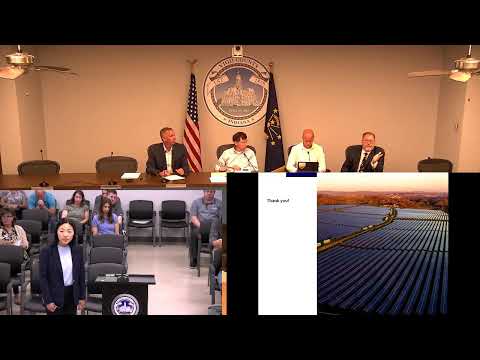
Developers of the proposed 175‑megawatt Hoosier Jack Solar Project told Vigo County commissioners on June 3, 2025, that they have signed a generator interconnection agreement and estimate construction will start between late 2025 and mid‑2026, with a target to complete the project by the end of 2027.
Developers of the proposed 175‑megawatt Hoosier Jack Solar Project told Vigo County commissioners on June 3, 2025, that they have signed a generator interconnection agreement and estimate construction will start between late 2025 and mid‑2026, with a target to complete the project by the end of 2027.
“We actually just signed our generator interconnection agreement for the project last year,” said Amber Kim, development manager for Dereva Energy, during a presentation to the commission. She said the project straddles Vigo and Sullivan counties, with about 900 acres in Vigo County and roughly 600 acres in Sullivan County, and will connect to an existing 138‑kilovolt transmission line owned by Duke Energy Indiana.
The project, Kim said, is sited largely on a reclaimed, decommissioned coal site and lies immediately south of a county‑designated Hoosier Jack megasite. Kim described the site as a brownfield reuse opportunity and said the 175‑megawatt project is roughly equivalent to supplying power to 35,000 homes.
Kim outlined economic expectations for the project, saying, “We anticipate that the total project investment will be upwards of $250,000,000,” with a developer estimate that more than $140,000,000 of that investment would be in Vigo County. She estimated the project would translate into upwards of $6,000,000 in total tax revenues over the life of the project, with “over $2,000,000” allocated to the county and “over $2,000,000” to the local school district; she also said Dereva expects as many as 200 construction jobs and a small number of permanent operations positions. Kim did not provide an annualized tax figure in that summary; when a commissioner asked whether the tax figures represented lifetime or annual amounts, Kim replied that the tax numbers were spread over the project’s lifetime.
Kim said the principal reason for delay since the project’s initial presentation in 2020 has been the grid interconnection process administered by the Midcontinent Independent System Operator (MISO). “Back in 2020 when we applied to the interconnection that whole process only took one year,” she said, but added that an increase in the number of projects seeking interconnection has extended that timeline to five years for many projects.
Patrick Smith, Dereva’s director of engineering, said the company’s original cost estimates have risen since 2020 and attributed the change to general inflation, new tariffs and higher costs to access the grid. “When we initially designed the project, it probably cost 40% less,” Smith said.
Commissioners questioned whether the project would produce property tax revenue immediately. Nathan Hagerman, legal counsel for the developer, confirmed the county previously approved a tax‑abatement resolution for the project in 2021. “We did do the…resolution for the abatement back in 2021,” Hagerman said, and he told the commission the abatement timeline as drafted for this project still accommodates the longer interconnection timeline if the project is completed within the approved build window; he referenced a build‑by deadline encoded in that earlier resolution.
A commissioner asked whether there was an economic development agreement (a payment in lieu of taxes) with the county; Kim responded that there is no EDA in place. Hagerman reiterated there was no EDA attached to the project as presented to the commission at this meeting.
Kim asked the commission and the public for input on local priorities and possible community benefits, including school or nonprofit partnerships. She said Dereva has rebranded since the last time it appeared before the county; the company was previously presented to the county as Duke Energy Renewables and was rebranded after acquisition by Brookfield.
No formal zoning or permitting action, EDA or change to the 2021 abatement resolution was taken at the June 3 meeting; the item was a developer presentation and Q&A.