Get Full Government Meeting Transcripts, Videos, & Alerts Forever!
Get email alerts on the Service Coverage And Contracts topic
No spam. Unsubscribe anytime.
Stakeholders say MassDEP plan must fix data and capacity gaps: 'Access' is not the same as 'served'
Summary
During the MassDEP household hazardous products work group meeting, municipal officials pressed the department to correct how the draft plan reports service coverage and to address vendor shortages on the state OSD contract; they urged a GIS gap analysis, clearer metrics and funding for year‑round service.
Several municipal officials at the MassDEP Household Hazardous Products work group meeting pressed staff to correct how the draft plan reports service coverage, arguing that current tables conflate theoretical access with actual household participation.
Jan (participant name on file) flagged language in the draft tables that lists items and shows percentages described as households “served.” Jan said that reporting access as “served” can give the false impression of high participation; she and others emphasized that many one‑day events reach only a small share of households. “I report how you know, that my facilities collect fire extinguishers or they collect electronics,” Jan said; “just because I report on the data sheet doesn't mean that it's a hazardous waste.”
Stakeholders asked MassDEP to:
- Replace or clarify the metric “served” with a clear distinction between households with access to a service and households who actually use the service (participation rate). - Publish town‑level or regional mappings of where permanent centers and one‑day events are located and how many months per year they operate, to make coverage gaps visible. - Identify vendor capacity limits and clarify which services are actually included in the upcoming OSD statewide contract (WMR001). Jan said only three vendors submitted bids on the previous FAC 110 contract, making statewide collection scheduling fragile.
Contract timing and vendor availability
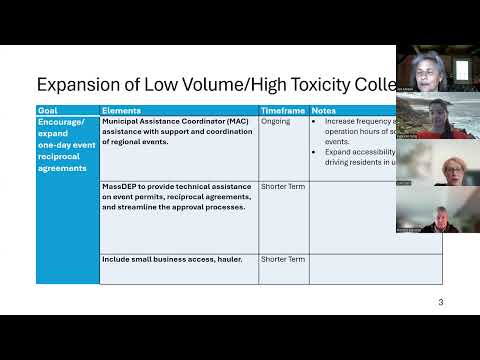
Jan and other participants asked for clarity about the Operational Services Division contracts cited in the slide deck. Caitlin King and staff noted the slide lists FAC 110 as expiring in June and WMR001 as effective July 1, 2025, and said MassDEP will clarify the vendor list and which collection services are covered by the new contract. Jan cautioned that several collection services—particularly permanent drop‑off collections—are not currently part of the statewide contract and will require separate arrangements.
Seasonality and off‑season gaps
Phil and others emphasized that many one‑day programs stop during October–April, creating large off‑season gaps in access, especially for households without reliable transportation. Stakeholders recommended MassDEP prioritize off‑season coverage when developing permanent‑site strategies and vendor agreements.
Suggested metrics and tools
Participants suggested adding at least two separate columns in the plan’s tables: one describing “access” (which communities have a collection option within a reasonable distance) and a second describing “use/participation” (how many households attended events or used permanent centers during the most recent reporting period). John (MassDEP staff) suggested that the department could explore GIS mapping of service gaps, and massDEP staff acknowledged additional data collection work would be required to produce town‑level participation statistics.
Funding and capacity implications
Multiple speakers connected data problems to funding realities: if participation were to increase to levels implied by “served” metrics, municipalities said costs would rise dramatically. Phil and Claire called for MassDEP to pursue broader funding options—federal grants, bond funding and other state agency resources—to meet the capital needs of additional permanent centers and to expand vendor capacity.
Next steps
MassDEP staff agreed to refine the plan text and tables, to clarify contract coverage under FAC 110 / WMR001, and to consider mapping options and clearer metrics distinguishing access from participation. No formal votes were taken; stakeholders were invited to submit written comments via the SWAC work group page and MassDEP committed to posting the meeting recording and revised materials there.