Get Full Government Meeting Transcripts, Videos, & Alerts Forever!
MassDEP lays out draft Household Hazardous Products action plan; stakeholders press for funding, year-round access and producer-responsibility policies
Summary
Caitlin King, Mercury Programs, Massachusetts Department of Environmental Protection, presented a draft Household Hazardous Products action plan that calls for more permanent collection centers, better vendor coordination and support for extended producer responsibility; municipal stakeholders urged clearer funding and year‑round access.
Caitlin King, Mercury Programs, Massachusetts Department of Environmental Protection (MassDEP), opened the work group meeting by presenting a draft Household Hazardous Products action plan and asking for stakeholder comments and questions. “This is the meeting for the MassDEP household hazardous waste, household products, household hazardous products action plan,” King said, introducing the plan and the tables the department circulated in the draft document.
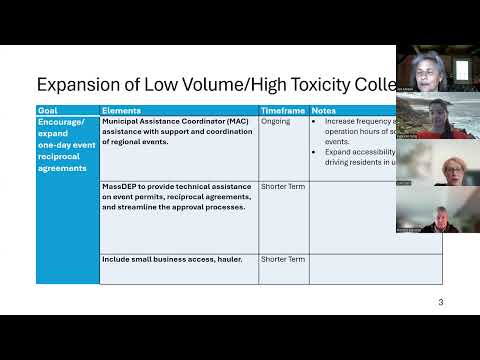
The draft lays out goals and elements across several themes: expand low‑volume/high‑toxicity collection (permanent collection centers); expand one‑day event reciprocal agreements and municipal assistance for events; pursue high‑volume/low‑toxicity collection improvements including support for extended producer responsibility (EPR) for paint and lithium‑ion batteries; public procurement of environmentally preferable products (EPPs); grants and capital investments; and education/outreach and disaster planning. Richard Blaschett, deputy division director of the hazardous materials management programs at MassDEP, described the presentation as refining earlier drafts and “tightening up” elements to make them more concrete.
Why it matters: stakeholders at the meeting repeatedly said the draft identifies key needs but lacks funding and operational detail needed for implementation. Municipal solid‑waste officials and program operators emphasized that access today is often seasonal and uneven; they called for clearer, sustained funding and operational commitments—especially more permanent…
Already have an account? Log in
Subscribe to keep reading
Unlock the rest of this article — and every article on Citizen Portal.
- Unlimited articles
- AI-powered breakdowns of topics, speakers, decisions, and budgets
- Instant alerts when your location has a new meeting
- Follow topics and more locations
- 1,000 AI Insights / month, plus AI Chat