Get Full Government Meeting Transcripts, Videos, & Alerts Forever!
Get email alerts on the Household Hazardous Products topic
No spam. Unsubscribe anytime.
MassDEP lays out draft Household Hazardous Products action plan; stakeholders press for funding, year-round access and producer-responsibility policies
Summary
Caitlin King, Mercury Programs, Massachusetts Department of Environmental Protection, presented a draft Household Hazardous Products action plan that calls for more permanent collection centers, better vendor coordination and support for extended producer responsibility; municipal stakeholders urged clearer funding and year‑round access.
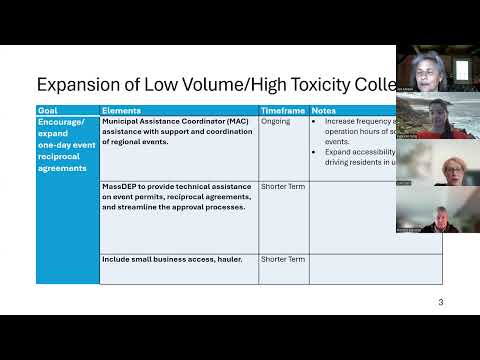
Caitlin King, Mercury Programs, Massachusetts Department of Environmental Protection (MassDEP), opened the work group meeting by presenting a draft Household Hazardous Products action plan and asking for stakeholder comments and questions. “This is the meeting for the MassDEP household hazardous waste, household products, household hazardous products action plan,” King said, introducing the plan and the tables the department circulated in the draft document.
The draft lays out goals and elements across several themes: expand low‑volume/high‑toxicity collection (permanent collection centers); expand one‑day event reciprocal agreements and municipal assistance for events; pursue high‑volume/low‑toxicity collection improvements including support for extended producer responsibility (EPR) for paint and lithium‑ion batteries; public procurement of environmentally preferable products (EPPs); grants and capital investments; and education/outreach and disaster planning. Richard Blaschett, deputy division director of the hazardous materials management programs at MassDEP, described the presentation as refining earlier drafts and “tightening up” elements to make them more concrete.
Why it matters: stakeholders at the meeting repeatedly said the draft identifies key needs but lacks funding and operational detail needed for implementation. Municipal solid‑waste officials and program operators emphasized that access today is often seasonal and uneven; they called for clearer, sustained funding and operational commitments—especially more permanent facilities and vendor capacity—to move beyond one‑day events.
Most urgent items and department responses
Permanent collection centers: The plan promotes expanding permanent collection centers through continued grant funding to municipalities and regional groups and by engaging hazardous‑waste companies to expand private permanent options. Phil (participant name on file), representing municipal managers and SWAC interests, asked for a published list of the 11 permanent centers and urged that the plan be linked to the Solid Waste Master Plan so stakeholders can track progress. Caitlin King said the permanent center list and related pages are on the SWAC website and that staff will put resource links in the chat and on the work group page. John (MassDEP commercial/solid‑waste staff) confirmed MassDEP created a household hazardous products work group web page and plans to post meeting recordings and materials there.
Vendor capacity and OSD contract changes: Jan (participant) and others flagged vendor capacity for statewide collections. Jan noted that only three vendors bid on the prior statewide contract (FAC 110), and that limited vendor participation risks leaving communities unable to schedule collections. Jan said the new OSD contract (WMR001) will take effect July 1, 2025, and participants asked MassDEP to clarify which services are on that contract and whether collection from municipal permanent facilities is included. MassDEP staff said some collection services are not on the statewide contract and that MassDEP is discussing use of permitted TSDF (treatment, storage, and disposal facility) infrastructure to expand ongoing collection opportunities.
Extended producer responsibility and other policy levers: The draft names EPR for paint and lithium‑ion batteries as priorities. Greg (MassDEP staff working with the EPR commission) said the EPR Commission is active and will meet on mattresses and paint; he said the commission will produce recommendations the legislature and administration can act on. Several municipal speakers urged MassDEP to work with the EPR commission, OSD and other agencies to develop momentum and to share case studies and procurement guidance.
Grants, staffing and outreach: The plan proposes continued use of the SMRP grant program for capital and technical assistance, new staff time to update web resources, and training and outreach to municipal officials. Stakeholders requested ongoing reporting and a follow‑up process so SWAC members and managers can see implementation progress; John said the work group will meet irregularly as needed and staff are open to periodic reporting back to SWAC.
Stakeholder concerns raised during discussion
Funding shortfall: Multiple municipal officials said SMRP and existing funds are unlikely to support the capital investment needed, particularly in urban areas. Phil and Claire (municipal officials) recommended that MassDEP pursue federal funds, bond bills, other state agency programs and private investment to expand permanent facilities.
Seasonal access and participation rates: Several speakers said that “access” in current tables is not equivalent to actual use—many one‑day events occur seasonally (off‑season gaps cited October–April) and participation rates are low (participants estimated single‑digit percentages of households). Jan asked that the department distinguish “access” from “served” in the plan’s metrics and consider mapping gaps at a town or regional level so the state can target underserved areas.
Clarify scope of materials: Stakeholders asked MassDEP to refine which materials belong in an HHP plan versus solid‑waste programs (examples discussed included propane tanks, tires and electronics). MassDEP staff said some items (e.g., propane tanks) are included because of explosion or ignitability risks and because residents bring them to HHP events; staff said other items (tires) will be removed or clarified in the draft text.
Next steps and commitments
MassDEP will maintain the household hazardous products work group page on the SWAC site and said recordings and materials from the meeting will be posted. Staff committed to clarifying contract language related to the OSD statewide contract (FAC 110 / WMR001) and to continuing discussions with permitted TSDFs and private vendors about permanent collection options and off‑season coverage. MassDEP also agreed to consider adding clearer metrics (access vs. use), to explore GIS mapping of service gaps, and to keep the work group engaged as the plan is revised.
Caitlin King closed the meeting by noting comments and email will be accepted and that the recording and draft plan will remain posted on the SWAC web page for further review.