Get Full Government Meeting Transcripts, Videos, & Alerts Forever!
Get email alerts on the Utilities Sewer Rates topic
No spam. Unsubscribe anytime.
Council refers proposed wastewater rate increases to finance committee after debate
Summary
After a two-hour presentation and public comment, the Common Council voted 6–4 to send a proposal on wastewater rate increases to the finance committee for further review. The original recommendation called for annual increases of 8.75% (2011–2015); Mayor Ross proposed using terminal tax revenue to cut the increases to about 4% for five years.
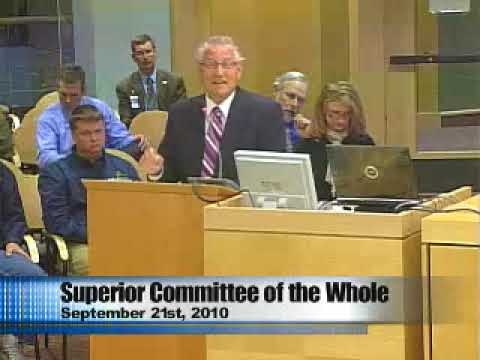
The Superior Common Council voted 6–4 on Sept. 21 to refer a proposal on wastewater rate increases to the finance committee after presentations from city staff and a public comment period.
The item before the Committee of the Whole with Power to Act initially recommended an 8.75% annual increase in sewer rates beginning January 2011 and continuing each year through January 2015. That original motion — made by Councilor Dalbec and seconded by Councilor Bridge — was withdrawn after Mayor Ross proposed an alternative funding approach that would use a portion of the city’s terminal tax revenue to lower the five-year increase to about 4%.
The referral to the finance committee carries significance because city staff and the presenters said the changes are driven by new regulatory expectations from the U.S. Environmental Protection Agency and the Wisconsin Department of Natural Resources and by local infrastructure needs.
Dan Romans, of the Environmental Services Division, outlined the regulatory and technical drivers behind the proposal, saying the city must address sanitary sewer overflows and basement backups and that the treatment plant has a front-end bottleneck that limits capacity. He said preliminary engineering puts “headworks” upgrade estimates at “equal to or greater than $10,000,000” and noted a chemical-feed system cost estimate of $1,600,000. Romans warned that some future technologies could be far costlier and that nutrient and ammonia limits in upcoming permits may require additional work and expense. He said the EPA is emphasizing enforcement, transparency and reductions in wet-weather pollution and nutrients.
Mayor Ross framed his alternate approach as a five-year compromise: applying a share of terminal tax revenues to the wastewater utility for five years, then returning allocations to their prior uses. He said the plan “will reduce the necessary wastewater rate increases from 8.75 to 4%.” Ross also argued for sensitivity to taxpayers, saying, “I don't care what sort of jargon you use to describe a rate or a fee increase, it's a tax increase.”
Finance staff and other presenters said the terminal tax contribution to the utility would be limited; the finance director later told the council the amount used in the mayor’s plan equates to roughly $250,000 (staff clarified the terminal tax has declined and that the city is working with the state to restore previous assessment levels). City staff also said the utility’s cash equity is limited relative to projected capital needs over the next five to 15 years.
Public commenters and several councilors urged caution and more public education. Speakers and councilors cited the economic stress on residents and businesses, the prevalence of renters who may bear rate increases indirectly, and the need for clear numbers and outreach before final action. Presenters said staff plans outreach and that the finance committee and public works committee previously reviewed elements of the study.
After debate the council made a motion to accept the mayor’s proposal (moved by Councilor Henry and seconded by Councilor Bender) and then voted to refer the matter to the finance committee (motion moved by Councilor McKenzie and seconded by Councilor Mertzig). The roll call on the referral recorded these votes: Olsen — yes; Bridge — no; Bender — yes; Mertzig — yes; McDonald — yes; Henry — no; Finsland — no; Herrick — yes; McKenzie — yes; Dalbec — no. The referral passed 6–4, which the council president said negated the motion to accept the mayor’s proposal.
Next steps: the council sent the rate proposal and supporting materials back to the finance committee for more study and public outreach before any final vote. No final rate increases were adopted at the Sept. 21 meeting.