Get Full Government Meeting Transcripts, Videos, & Alerts Forever!
Get email alerts on the Public Safety Drugs topic
No spam. Unsubscribe anytime.
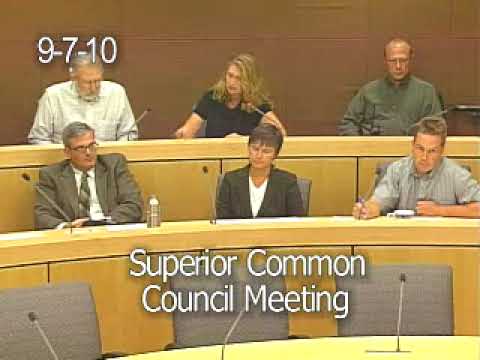
Superior council adopts ordinance banning synthetic cannabinoids, 9-1
Summary
At its Aug. 17, 2010 meeting the Superior Common Council passed an ordinance prohibiting the sale, manufacture and possession of synthetic cannabinoids in the city, citing public-safety and the risk of rapid business establishment; the vote was 9–1.
The Superior Common Council adopted an ordinance Aug. 17, 2010, banning the sale, manufacture and possession of synthetic cannabinoids in the city by a 9–1 roll-call vote.
Council members and police officials said the ordinance aims to prevent businesses that sell chemically treated herbal products from rapidly locating in Superior and to give the city legal grounds to restrict those products. Supporters described enforcement and market-availability concerns as the driving rationale.
Assistant Chief Legess of the Superior Police Department told the council he was not aware of recoveries of the product in Superior but described public-safety risks linked to the chemical formulations used on plant material. “It is a health risk in my view,” Legess said during the discussion, adding that users can experience hallucinations, paranoia and other acute reactions. Council members also said distributors told them they could set up shop quickly if the city delayed action.
Councilor Finsland introduced the ordinance and Councilor Dalbec seconded the motion to adopt it without sending it to committee for further hearings. Councilor Mertzuk pressed for postponing action to allow health professionals to present evidence; he was the lone recorded “no” in the roll-call vote. Several other councilors, including Bridge and Bender, said the city should act quickly to avoid becoming a regional distribution point.
Councilor Bender noted that state law already outlaws many THC analogues under Wis. Stat. ch. 961 and that recent state action had targeted specific herbal products, but he and others said municipal language must cover additional chemical formulations that distributors can alter. “They will reformulate this overnight,” a councilor said the distributors warned, prompting proponents to pass the ordinance now and update it later if needed.
The ordinance was approved by roll call: Olsen, Bridge, Bender, McDonald, Henry, Finsland, Herrick, McKenzie and Dalbec voted yes; Mertzuk voted no.
The council directed city staff and law enforcement to proceed with enforcement under the new ordinance and signaled the ordinance may be amended in future meetings as new chemical formulations appear.