Get Full Government Meeting Transcripts, Videos, & Alerts Forever!
Get email alerts on the Public Safety Surveillance topic
No spam. Unsubscribe anytime.
Dayton police present 2024 surveillance report detailing cameras, ALPRs, drones and Real Time Crime Center
Summary
Major Jason Hall, East Division Patrol Commander for the Dayton Police Department, presented the department's 2024 annual surveillance report at the Dayton City Commission meeting, outlining changes to video and sensor technology, usage statistics and costs, and steps the department says it takes to protect civil liberties.
Major Jason Hall, East Division Patrol Commander for the Dayton Police Department, presented the department's 2024 annual surveillance report at the Dayton City Commission meeting, outlining changes to video and sensor technology, usage statistics and costs, and steps the department says it takes to protect civil liberties.
The presentation, Hall said, described the department’s move after FUSIS was discontinued in 2024 to Flock OS to aggregate live video and sensor feeds; updates on the body‑worn camera and in‑car recorder programs; the deployment and use of automated license‑plate readers (ALPRs); and expanded use of unmanned aerial systems (UAS). “The purpose of this is to give you an overview of the surveillance report … to ensure transparency and protect the civil liberties of the citizens of our city,” Hall said.
Commissioners pressed for more data and safeguards. Commissioner Charles Lawson requested the location of the full report and asked for evidentiary data showing how the technology affects crime; Hall said the full report is linked on the police department website and that the report contains vignettes as well as deployment statistics. Commissioner Turner Slaus and Commissioner Fairchild asked about training and annual policy updates; Hall and other staff described training requirements for drone pilots and the department’s audit processes for body cameras.
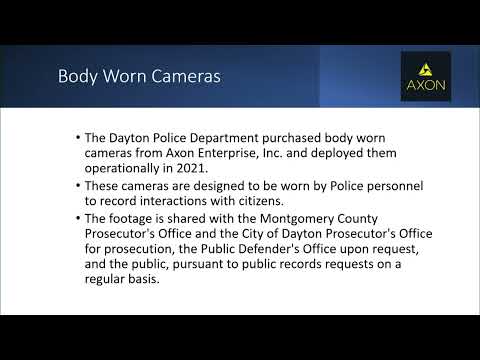
Key details provided in the presentation and commissioner discussion: - Policy and vendor changes: FUSIS technology was discontinued in 2024 and replaced by Flock OS; General Order 3.02‑11 governing FUSIS was rescinded (as described in the presentation). (Jason Hall) - Body‑worn cameras: the Dayton Police Department partnered operationally with Axon Enterprises in 2021. The department reported 14 training memorandums and two oral reprimands issued in 2024 for officers who failed to activate body cameras on time or at all; the department said it found no instances of improper access or dissemination of body‑camera data. (Hall) - Costs reported for 2024: body‑worn hardware/software/licenses $365,377; Fleet (in‑vehicle) system $334,331; fixed ALPR program (72 fixed ALPRs in operation) $188,250; initial fixed‑site ALPR deployment used $98,975 in federal grant funds; Flock OS service cost cited at $49,736; UAS maintenance and repair $22,337.48. (Hall) - UAS (drones): the department reported using UAS technology on approximately 370 occasions in 2024 and owning 16 systems. Hall showed a deployment vignette in which a UAS aided officers in locating a man with a handgun and the department said the device helped avoid a more dangerous encounter. (Hall) - Real Time Crime Center: the department described a new central facility that aggregates live camera feeds, ALPR hits and calls for service to support investigative and patrol responses; staffing began in January (Hall said he assigned a person to start the unit on restricted duty January 13). The center is described as a centralized hub to coordinate technology and tactical response—not a replacement for existing command centers. (Hall)
Commissioners repeatedly asked for more quantitative evidence that the layered technologies reduce crime or offer cost‑benefit justification. Major Saunders (senior department official during the presentation) cautioned that the department could not credibly give a specific percentage reduction in crime tied to any single technology and emphasized the need to evaluate tools over time and in combination. “It would be wrong to try to tell you that … if we deploy this technology, it’s gonna reduce this type of crime by this percentage,” Saunders said.
On policy and oversight, Commissioner Fairchild asked for an update from the law department on a previously requested ordinance revision to require the annual report and pre‑deployment reporting for new technologies. The city manager said the law department and staff have had ongoing discussions; no new ordinance was enacted at the meeting. Commissioners and staff said the department retains audit logs indefinitely even when routine retention schedules for the raw footage are typically about 30 days.
Why this matters: commissioners framed the report as part of legally mandated transparency and public oversight of surveillance tools; they emphasized the need to balance civil liberties, training and cost effectiveness. Commissioner Joseph urged residents to read the full report on the City of Dayton website and called annual reporting an example of public accountability. “This is exactly what I envisioned when we put this together,” Joseph said.
The presentation closed with staff offering to provide additional operational details and historical comparisons on request; Hall and other staff agreed to follow up with commissioners about the specific data points they requested.
Ending: The commission did not take a formal vote on new surveillance policy at the meeting. Commissioners requested additional data and said they will continue oversight conversations and consider law‑department suggested ordinance updates on reporting requirements.