
Los Altos school leaders warn of shrinking enrollment and multi‑year budget gaps; reserves recommended
Get AI-powered insights, summaries, and transcripts
Sign Up Free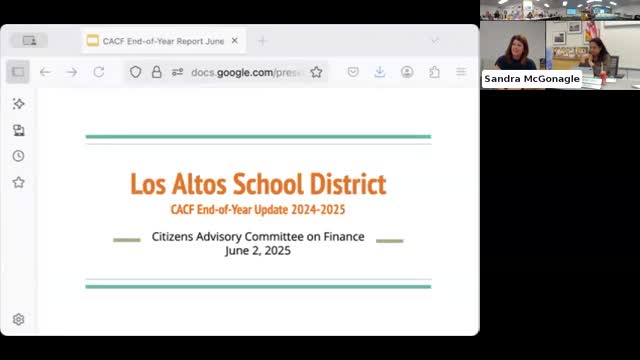
Summary
At the Los Altos School District board meeting, the district’s finance advisory committee and business office presented enrollment and budget projections showing a likely multi‑year gap and urged using reserves to smooth reductions and buy time for planned changes.
At the Los Altos School District board meeting, the district’s citizen advisory committee on finance and the district’s chief business official presented an enrollment forecast and multi‑year budget projections that, they said, require near‑term planning to preserve educational quality.
The advisory committee’s chair, John Michaelson, told trustees that long‑term demographic shifts — primarily lower birth rates — mean fewer students will move into the district over the next decade. “Unless something very surprising happens,” Michaelson said, enrollment “is going to go down,” reducing the number of cohorts feeding into junior high and increasing per‑student fixed costs.
The district’s business director, Eric Hornsby, presented a multi‑year budget that projects a general‑fund deficit of about $2.2 million in 2025–26 and larger shortfalls in subsequent years (roughly $3.3 million and $3.7 million in later out‑years) under current assumptions. Hornsby said the district will adopt a revenue assumption of 4.75% property‑tax growth for the coming year and that final property‑tax totals will not be known until August. He described the importance of reserves to avoid short‑term borrowing and to give the board time to plan measured reductions rather than abrupt cuts.
“Reserves mean that we don’t have to do a chainsaw approach,” Michaelson said, urging the board to use reserves thoughtfully to spread adjustments over time and protect classroom services. Hornsby described scenarios showing that slower property‑tax growth or a sharp recession would erode reserves faster, and recommended the board consider reserve policy changes as part of long‑range planning.
Trustees and presenters discussed several specific fiscal drivers: rising pension costs (CalSTRS/CalPERS contributions), increasing utility and health‑benefit costs, and the district’s status as a basic‑aid district (in which local property tax revenues provide the majority of funding). Hornsby highlighted special education as a large and growing share of expenditures and noted the district supplements state and federal special‑education funding from the general fund.
Board members asked for more granular enrollment triggers (for example, thresholds that would require consolidation or configuration changes), and several trustees supported studying a higher reserve target; one trustee asked that a 15% reserve target be placed on a future agenda for deeper review.
No formal board action was taken at the meeting on specific budget reductions. Hornsby said the district will return to the board at the next meeting to adopt the 2025–26 budget, following the public‑hearing step required by state law.
The presentation and discussion leave open several follow‑up items for trustees: refine enrollment scenarios with updated local cohort data, identify clear operational triggers tied to enrollment thresholds, and revisit the district’s reserve policy and multi‑year staffing plan.