Get Full Government Meeting Transcripts, Videos, & Alerts Forever!
Get email alerts on the Land Use Windblade Recycling topic
No spam. Unsubscribe anytime.
Benton County supervisors deny permit for proposed wind‑turbine blade recycling and storage site near Mount Auburn
Summary
The Benton County Board of Supervisors voted to deny a land‑use change that would have allowed a company to store and shred wind‑turbine blades at a former egg‑laying farm northeast of Mount Auburn, citing incompatibility with the county's rural land‑use plan and unresolved environmental and community concerns.
The Benton County Board of Supervisors voted to deny an application to change the use of roughly 20–28 acres northeast of Mount Auburn for a wind‑turbine blade recycling and storage facility, saying the proposed industrial activity would be incompatible with the county's rural land‑use policies and could materially affect nearby farm operations and residents.
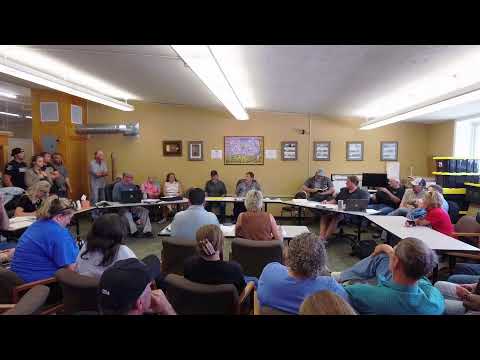
County staff briefed the board at a public hearing that the site, on three parcels controlled by Farmtastic 3 LLC, is in the county's general rural use area and that the proposal did not meet criteria in the county's agricultural land preservation ordinance and comprehensive plan. "The use does not materially alter the stability of the overall land use pattern in the area," a county staff member reciting the ordinance criteria told the board during the hearing.
The applicant, identified in testimony as Destructible, Inc., described an operation the company said would cut, shred and temporarily store blade material indoors before shipping processed material to a recycler the applicant named as Regent Fiber (an Alliant Energy‑owned recycler mentioned by the applicant). "We don't want these blades going to a landfill," Jared, the project manager for the applicant, said during his presentation, describing indoor shredding, water spray mitigation on saws and planned silt fences and stormwater controls.
Residents and several local landowners urged denial. Speakers at the hearing raised concerns about airborne fiberglass dust, water runoff to a nearby creek and the Cedar River, long‑term liability if a small company folded, and the effect of the operation on property values and county roads. Josh Peterson, an engineer and adjacent landowner, told the supervisors he had reviewed other Iowa sites and described state investigations and enforcement actions at locations he cited as precedents for concern.
Applicants answered technical questions about operations: they said trucks would arrive with blade panels already cut and that the site would use a large tracked diesel shredder inside a covered structure; they estimated water use for saw cooling and dust suppression of under 500 gallons per day per saw, and said their shredder can process roughly 10 tons per hour and that a typical repower flow would generate about 60 tons per day to be handled. Company representatives also said they hold a contract slot to deliver shredded material to Regent Fiber and that they had a bond and insurance (testimony: "the project is fully bonded").
Board discussion and the final vote centered on compatibility with Benton County's land‑use plan and open questions about the environmental and community impacts. The motion to deny the application said the proposed non‑agricultural use was inconsistent with the county ordinance and could adversely affect adjacent property owners, farming operations and the character of the area. The motion passed after a recorded vote. Supervisor Tippett voted in favor of denial; Supervisor Seaman voted against; the board recorded a majority vote to deny the application.
What happens next: the denial means the applicant cannot proceed under the proposed land‑use change. County staff and the supervisors said they expected additional follow‑up, including review of bonds, permitting requirements and any further submissions the applicant might offer. Several residents asked the county to coordinate with state agencies and neighboring counties on environmental reviews and road impacts.