Get Full Government Meeting Transcripts, Videos, & Alerts Forever!
Get email alerts on the Speed Detection School Zones topic
No spam. Unsubscribe anytime.
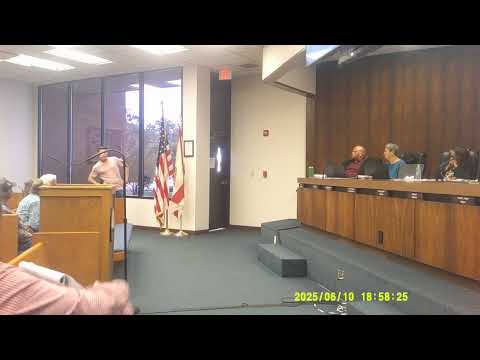
Live Oak council hears concerns, questions on school‑zone speed detection ordinance
Summary
At a City of Live Oak public hearing on ordinance 15‑35, residents and a vendor debated installing automated speed detection in school zones; council members asked for clarifications and did not take a final vote.
The City Council of the City of Live Oak opened a public hearing on ordinance 15‑35, which would authorize placement and use of speed detection systems in school zones, and heard multiple public comments and a vendor presentation but did not vote on the ordinance at the meeting.
Council members and members of the public said the proposal touches on school‑safety, enforcement capacity and privacy, and several speakers urged further study before any contract is awarded.
David Book, a representative of Blue Line Solutions and a retired law enforcement officer, told the council his firm conducted speed studies at city schools ‘‘in a one‑week period of five days’’ and recorded ‘‘4,400 people that were speeding 11 miles an hour or over your schools.’’ He described a program that begins with a site assessment, public information and a 30‑day warning period and said the company’s approach typically yields an ‘‘80 [percent] reduction rate’’ in speeding before citations are issued. Book said his firm’s program includes signage, speed feedback signs, flashing lights and camera systems and that citations would start after the warning period, citing a $100 fine for drivers 11 mph over the posted school‑zone speed.
Wayne Hanford, representing Concerned Citizens of North Florida, told the council the city should first determine whether a speeding problem exists and suggested using the sheriff’s department or other existing equipment to record speeds before contracting with a private company. ‘‘If we do have an issue, then that tells me that we’re not enforcing our laws,’’ Hanford said, adding that a recent pedestrian crash in a school zone was reported to involve a driver on a phone.
Resident Adam Collins said he opposes camera enforcement and urged local, low‑cost alternatives such as increased officer presence. ‘‘I don’t want cameras watching me,’’ Collins said, adding that he sees police in school areas and believes the community can ‘‘figure it out’’ without automated systems.
Other residents raised privacy and data‑security concerns, noting risks of data breaches and the potential for expanded surveillance over time. One resident warned that approval could start a ‘‘slippery slope’’ toward additional camera and AI uses and said the community ‘‘doesn’t want people watching us.’’
During council discussion, a member of the dais clarified that adopting the ordinance would authorize implementation of speed detection systems but would not itself award a contract. The ordinance, the speaker said, would still require an appropriate bidding process and separate contract approval. That clarification included how the ordinance would apply timing and posted speeds: the reduced school‑zone speed would take effect 30 minutes before and 30 minutes after a regularly scheduled school session and would revert to the regular posted speed outside those times.
Council members raised technical questions about where the reduced speed would apply and whether some stretches of roadway (the transcript cited Highway 129) would be subject to a 20 mph school‑zone speed ‘‘all day’’ if lights were not managed as described. The transcript includes a vendor statement that a zone was previously ‘‘extended the school zone a 100 d in each direction’’; council members asked staff to clarify that language and the precise distances and signage that would govern enforcement.
No motion to adopt ordinance 15‑35 appears in the transcript and no vote was recorded at this meeting. Council members expressed a mix of caution and interest in alternatives such as targeted officer overtime for short school‑period coverage.
Next steps identified by council members and staff in the discussion include further review of ordinance language (particularly timing and zone boundaries), additional community input on privacy and data‑security safeguards, and following the required competitive bidding process before any vendor contract could be executed.