Get Full Government Meeting Transcripts, Videos, & Alerts Forever!
Get email alerts on the City Budget topic
No spam. Unsubscribe anytime.
Delray Beach previews $23.9M budget gap; commission agrees to pursue SAFER grant and hold 3‑on‑rescue staffing
Summary
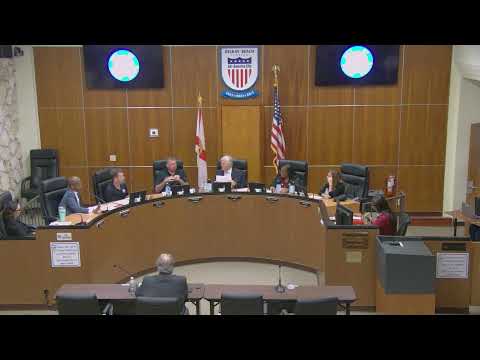
Delray Beach officials at a June 10 workshop outlined a preliminary $23.9 million general‑fund shortfall for FY 2025‑26 and won commission consensus to pursue a FEMA SAFER grant and to preserve three‑person staffing on rescue units while staff returns with funding options.
Delray Beach officials at a June 10 workshop outlined a preliminary $23.9 million general‑fund gap for fiscal 2025‑26 and won commission consensus to pursue a FEMA SAFER grant and to preserve three‑person staffing on rescue units while staff returns with funding options.
City Manager Moore and Chief Financial Officer Henry Dackowitz presented the preliminary numbers at the workshop and described cost, revenue and reserve assumptions used to close the gap ahead of the formal proposed budget. Moore said the department heads— initial requests were included in the projection and that the city has to weigh how to fund a contractual shift change in Fire Rescue that takes effect Oct. 1, 2025.
“We do not believe the city is in position to entertain a fire assessment in time for Oct. 1, 2025,” Moore said, explaining Delray Beach lacks a public safety assessment other municipalities use. CFO Henry Dackowitz gave the numeric summary: the 2025 amended budget baseline was about $189.2 million; baseline revenue for 2026 was projected at $177.9 million (an $11.3 million revenue shortfall after excluding a $10 million reserve drawdown in the current year). Projected expenses rose to $201.8 million, producing the $23.9 million gap when combined with the revenue shortfall.
Dackowitz detailed the staff approach to close the gap: take 50% of the current vacancies as a budgeted savings ($4.74 million in vacancies, with $2.37 million applied in the plan); apply assumed attrition savings (3% for police, fire and parks; 1% for other departments) totaling about $1.9 million; reduce nonpersonnel operating budgets by 5% (about $3.96 million); and cover the remaining shortfall with an unspecified drawdown from unassigned reserves of about $6.9 million. With those assumptions the city projects unassigned fund balance would fall to roughly $39.6 million at year end and the fund‑balance‑to‑expenditures ratio to about 20.5%, slightly below the city’s stated 21% guideline.
The presentation highlighted personnel changes driving the pressure: the police department request was shown rising from about $50.3 million to $59.59 million (an increase of roughly $8.68 million) and the Fire Rescue request was shown at about $50.4 million, up roughly $1.2 million from the current year after internal cuts. Moore and Dackowitz said the gross cost of moving Fire Rescue from a 24‑48‑8 shift to 24‑72 (a contractual change) could be much higher without internal efficiencies identified by staff and the fire department.
Fire Chief Ron Martin described a potential near‑term funding opportunity and its constraints: the FEMA SAFER recruitment and retention grant, which Chief Martin said would fund new firefighter hires on a cost‑sharing basis (75% first and second years; 35% the third year for the first‑year salary) but requires the city to retain those positions after the three‑year grant period. “This is a very competitive process,” Chief Martin said, and he warned the success rate is low; he also noted the application would require documentation of local financial need and a sustainability plan should the city be awarded funds.
Given the timeline and the commission—s interest, staff sought and received commission consensus to prepare a SAFER application and to place a formal authorization on the June 17 regular meeting agenda. Moore said the grant submission deadline staff is using for planning is July 3, 2025; Chief Martin said the application must be assembled quickly and that a formal acceptance vote would return to the commission only if the grant is awarded.
On operations, Chief Martin presented an option to reallocate suppression resources (temporarily reducing suppression capability in a zone in order to increase EMS coverage), an approach he characterized as “risk‑based” and which would carry tradeoffs, including potential ISO (insurance service) and automatic‑aid impacts. Several commissioners said they opposed reducing suppression capability. Commissioner Cassell pressed city leaders to be transparent about whether the budget assumptions were realistic and about the risk of mid‑year amendments; she asked whether savings proposed had been validated and said, “I want to make sure we didn—t find them for the sake of the presentation.”
Commission consensus decisions at the workshop included: (1) staff will prepare and submit a SAFER grant application for commission authorization June 17 if staff deems the application complete; and (2) the commission expressed consensus support for maintaining 3‑person staffing on rescue units (the 3/3 EMS structure) and directed staff to return with funding options, including millage scenarios, for the July budget presentations. City staff noted a millage change from the current rollback rate (5.9063) to about 6.0039 was calculated to raise roughly $1.4 million to cover part of the difference related to the 24/72 transition while maintaining 3/3 EMS, but staff emphasized additional options would be brought forward in July.
Moore and Dackowitz also laid out next steps and schedule: staff will circulate more granular budget worksheets on short notice, the city manager will present a proposed balanced budget at the July 8 workshop, a town‑hall on the recommended budget is scheduled for July 24, and tentative and final budget hearings are planned for Sept. 2 and Sept. 16. Commissioners asked for detailed line‑by‑line information on the 5% nonpersonnel reductions and a list of the vacancies being held as part of the budget assumptions.
The workshop produced several clear directions — prepare a SAFER application, preserve 3/3 EMS staffing in the near term and return in July with revenue and expenditure options — while leaving major policy choices (millage setting, potential assessments, or structural changes to suppression coverage) for later public deliberation.