Get Full Government Meeting Transcripts, Videos, & Alerts Forever!
Get email alerts on the Traffic Calming topic
No spam. Unsubscribe anytime.
NDOT proposes speed cushions, radar signs and lane narrowing for Ben Allen Road to curb speeding
Summary
At a virtual meeting on June 9, 2025, the Nashville Department of Transportation (NDOT) presented a draft traffic‑calming design for Ben Allen Road that would add speed cushions, radar feedback signs and painted edge‑line narrowing to reduce neighborhood speeds and improve pedestrian safety.
NASHVILLE, Tenn. — At a virtual meeting on June 9, 2025, the Nashville Department of Transportation (NDOT) presented a draft traffic‑calming design for Ben Allen Road that would add speed cushions, radar feedback signs and painted edge‑line narrowing on the widest sections to reduce neighborhood speeds and improve pedestrian safety.
NDOT facilitator David Greaves said the project was selected from more than 600 neighborhood applications and ranked in the city’s top 25 for traffic calming; he cited NDOT field measurements showing about 440 vehicles per day with an 80th‑percentile speed near 40 mph on parts of Ben Allen. "They're about 3 inches high, they're 6 feet wide, and they come in a variety of lengths, seven‑fourteen feet," Greaves said of the speed cushions the department commonly uses.
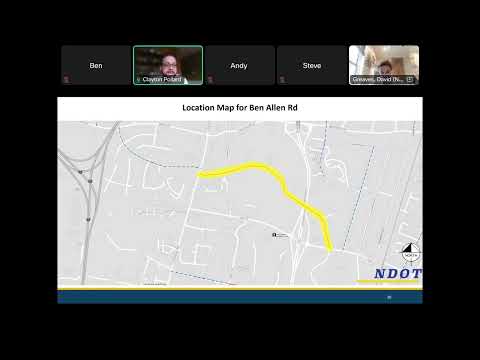
The plan Greaves walked through includes sets of speed cushions placed just past Highlander Drive and at the bottom of a steep hill, a cluster of four cushions flanking a newer apartment complex, radar feedback signs in locations too steep or curved for vertical measures, and edge‑line narrowing across a 42‑foot bridge near Ellington Parkway. Greaves said spacing in one area is around 400 feet and that cushions are not placed within 15 feet of driveways to avoid interference with backing movements.
Why it matters: Greaves framed the effort as part of the city’s Vision Zero goal to eliminate traffic deaths and serious injuries, explaining that lower impact speeds increase survivability for pedestrians and cyclists. He cited a March 2023 study of six NDOT projects where average speeds dropped from 31 mph to 22 mph after vertical treatments and the 80th‑percentile speed fell from 37 mph to 25 mph.
Neighbors at the meeting described frequent speeding and blind curves along the short, winding road. "People just speeding and kind of, I mean, yeah, definitely speeding and doing, you know, oddball things like passing the double yellow lines," said Clayton Pollard, who told the group he has lived on Ben Allen for 15 years. Andy, who identified himself as a business owner at Blevins Incorporated, echoed that account: "I've worked on this road since 1994, and I've seen cars, at very high rates of speed and it's very dangerous," he said.
Several participants asked whether NDOT would add sidewalks as new apartment development increases; Greaves said sidewalks are not part of this traffic‑calming project and are typically addressed through separate capital projects or developer requirements, but they can be requested through the city’s HUB reporting system. Councilmember Sean Parker noted that Hart Lane and Dickerson Pike are slated for work under the city’s Choose How You Move transit plan and said signalization at either end of Ben Allen "is possible" as those corridors are upgraded.
Process and timeline: NDOT staff said the next steps are a site visit to finalize grades and widths, preparation of construction plans, then either a second neighborhood meeting to review plans or posting plans online and proceeding to an online ballot. If two‑thirds of returned ballots approve the vertical measures, the project would be placed in the construction queue with an estimated lead time of about eight to ten months. Greaves said if the ballot fails to reach the two‑thirds threshold, NDOT typically pursues a non‑ballot design that uses paint, radar signs and other measures that do not require the ballot.
Ballot eligibility and outreach: NDOT will mail a postcard and ballot to eligible property owners (residential properties, churches and schools that touch the street); vacant parcels are ineligible and multiple properties owned by the same owner are de‑duplicated so one mailing equals one vote. Staff offered to provide the mailing list to neighborhood volunteers who want to canvass ahead of balloting.
Operational details and concerns: Greaves described material and operational issues raised by residents, including plow clearance (he said plows can raise the blade and that rubber cushions tend to shed snow and melt) and driveway spacing constraints that shaped cushion locations. Greaves also noted safety limits: vertical devices are not placed on blind curves or where grades exceed design thresholds, which is why radar feedback signs are proposed for those locations.
What’s next: NDOT will perform a site visit, finalize a design and schedule a short neighborhood meeting to review plans before balloting. For more information or to submit feedback, Greaves asked participants to use the live survey at engage.nashville.gov/trafficcalming and to copy m.trafficcalming@nashville.gov on email communications.