Get Full Government Meeting Transcripts, Videos, & Alerts Forever!
Get email alerts on the City Budget topic
No spam. Unsubscribe anytime.
Pacifica council narrows FY budget, directs seed funding for shoreline, events and housing implementation
Summary
The Pacifica City Council on Monday reviewed its draft fiscal year budget and directed staff to package a final recommended budget for adoption June 23 while providing seed funding for shoreline planning, library outreach, festival support and housing implementation work.
The Pacifica City Council on Monday reviewed its draft fiscal year budget and gave staff direction to package a final recommended budget for adoption June 23 while providing seed funding for several priorities, including a $150,000 placeholder for shoreline adaptation planning, a one‑year library outreach allocation, $40,000 for OneShoreline and $25,000 for Fog Fest.
Council members and staff framed the meeting as a revenue‑and‑priorities discussion in a year the city is facing structural shortfalls and major state housing mandates. City Manager Kevin Woodhouse said the work ties into a broader revenue strategy that includes studies of tax‑increment financing, sales‑tax generation and surplus‑land opportunities.
The seed funding decisions were framed as limited, start‑up or one‑time allocations rather than long‑term ongoing commitments. “This is our seed money to get started on that, to hire a public engagement consultant, start framing out the milestones,” Community Development Director Samantha Updegrave said about the Shoreline Adaptation Program, which staff reduced from an earlier, larger request to $150,000 in the draft budget. Updegrave said the amount will be used to design public engagement and preliminary technical work that will support grant applications.
Why it matters: Pacifica faces both near‑term budget pressure and state enforcement risk tied to its housing element. Council members repeatedly linked revenue generation, economic development and housing policy, and asked staff for a summer study session on revenue options and follow‑up reporting on implementation of the Economic Opportunity Study.
Most important decisions and directions
- Shoreline adaptation: Council agreed to include $150,000 in the draft budget as seed money for a Shoreline Adaptation Program and related coastal access/resiliency work. Staff explained the funds are intended for public engagement consultants and initial technical studies and said the city will pursue outside grants to carry later phases.
- OneShoreline and Fog Fest funding: Council members reached consensus to allocate $40,000 to OneShoreline and $25,000 to Fog Fest in the coming year and identified available local funds and reallocation options to cover those requests. Council directed staff to finalize the funding source details in the final recommended budget.
- Library outreach: The council agreed that the one‑year library public engagement/marketing allocation should be covered by the Pacifica Library Fund for this fiscal year (the fund had a projected balance of about $53,000), freeing up general‑fund capacity; staff said polling and other ongoing marketing costs would be evaluated later.
- Housing and economic development reorganization: Council discussed a proposed reorganization that would consolidate economic development and housing responsibilities into an “economic development and housing manager” role. Staff described the structure as a trend in neighboring cities and said the position would support both market‑rate and affordable housing implementation work. Council members asked staff to revisit midyear and to continue work on a housing action fund and other revenue tools.
Other budget items discussed
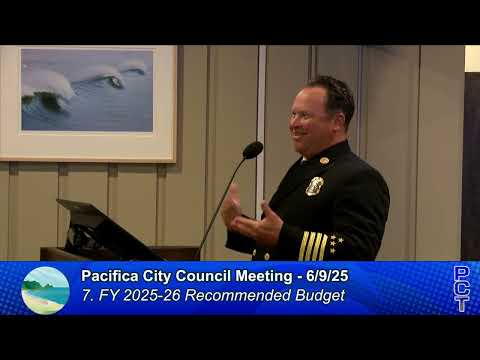
- Public safety equipment and reserves: Deputy Fire Chief Joel Abelson of North County Fire Authority walked council through planned replacement cycles: turnout gear is on a 10‑year lifecycle (purchased in pairs on a five‑year rotation), turnout replacement is estimated at about $150,000, and replacement of about 22 self‑contained breathing apparatus (SCBAs) is projected to cost in the neighborhood of $300,000 when purchased together. Abelson said the city has created a reserve to set money aside for these life‑safety purchases. “This is life‑safety equipment,” Abelson said, adding that the department looks for grants and regional purchasing efficiencies but needs funds reserved in advance.
- OPEB/pension contributions: Staff explained Other Post‑Employment Benefits (OPEB) contributions affect the city’s audited unfunded liability calculations; staff said actuarial valuations determine the accounting impact and reminded council that contributions are a council policy choice with long‑term implications.
- Short‑term rental (STR) enforcement: Staff reiterated that the proposed STR permit program includes inspection and enforcement costs. The STR permit fee currently is about $1,600; staff told council the quoted enforcement costs (code‑enforcement and building‑inspection time plus consultant work) are real and may exceed fees unless revisitied in a future user‑fee study.
- Capital improvement program (CIP): Council members requested clearer CIP project sheets tying each project to council goals, climate action, and project funding status. Public works staff said they will roll out a revised CIP template after budget adoption that makes project status and multi‑year projections clearer.
Public comment and community concerns
Members of the public urged caution on shifting resources away from economic development and commercial revenue generation, pressed for more detail on the economic opportunity recommendations, asked for a clearer plan for the housing element implementation and warned about risks the city could face from failing to meet Regional Housing Needs Allocation (RHNA) obligations. One public commenter said the city should not rely primarily on housing to meet revenue needs and cited infrastructure concerns such as sewer overflows.
Council process and next steps
Council members asked staff to prepare a final recommended budget with the directions given at the session and to present a separate, more detailed revenue study session this summer that will analyze the economic opportunity recommendations and quantify potential revenue from development scenarios. Staff reiterated the city’s two‑step adoption timeline: finalize the recommended budget at the June 9 meeting and adopt it on June 23.
Votes at a glance
- Motion to extend the meeting to 11:30 p.m.: made by Council Member Wright and seconded by Mayor Beckmeyer; passed unanimously.
What council asked staff to return with
- A revenue study session this summer that quantifies the economic opportunity study recommendations and potential impacts of housing and commercial development on sales tax, transient occupancy tax and property tax. - A midyear review of the proposed economic development/housing reorganization and the staffing allocations tied to the housing fund. - Finalized funding‑source recommendations for the $40,000 OneShoreline request and $25,000 Fog Fest request as packaged in the recommended budget for adoption June 23.
Tight timeline: Staff said the council’s comments from this session will be incorporated into the recommended budget and that adoption is scheduled for June 23, with any remaining cleanups handled at midyear or during subsequent budget housekeeping.